





Ossé calls on Hochul to halt evictions for deed theft victims
- Council member says homeowner protection funding in governor’s budget is not enough
- Under a related state law, AG and DAs intervened to pause evictions in a handful of cases
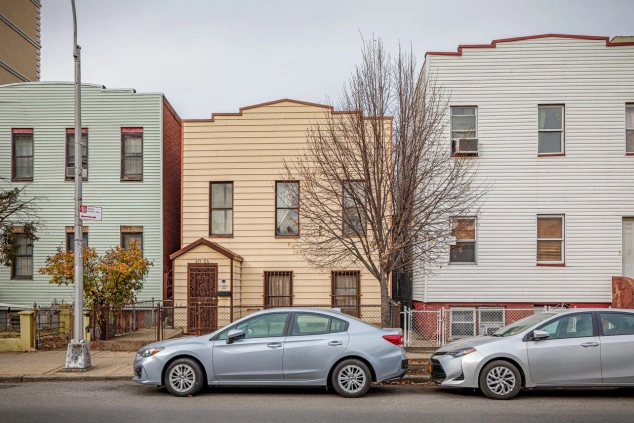
Council Member Ossé also wants NYC to create a “cease-and-desist zone” for solicitation in deed theft hot spots.
iStock
New York City Council member Chi Ossé and the People’s Coalition to Stop Deed Theft are calling on Governor Kathy Hochul to use her power to temporarily keep owners fighting deed theft in their homes until broader protections are put into place.
For now, Ossé wants Hochul to impose a temporary moratorium on evictions for victims of deed theft, and the Brooklyn council member’s initiative also outlines a raft of other reforms the state can take to prevent more owners from losing their homes.
Those include a “cease-and-desist zone” for solicitation in deed theft hot spots, an expansion of the right to counsel, more transparency around LLCs, and increased oversight of the courts.
Hochul’s state budget proposal already includes $40 million for the Homeowner Protection Program, which funds housing counseling and legal help for New Yorkers at risk of foreclosure. But Ossé’s office said HOPP-funded counselors and attorneys can’t keep up with demand for support, a result of the rapid pace of evictions and displacement.
Current solutions aren’t enough, advocates agree
Bill Leinhard, a partner at Lienhard & Grumbach, a law firm that fights deed theft in Brooklyn and Queens, said in a letter to Hochul that his firm firmly supports the recommendations. An eviction moratorium is a helpful “stopgap measure,” he said.
“This letter is ‘we have a crisis and we have available policy solutions already and they don’t go far enough. We need the governor to intervene,’” he said.
Ossé’s initiative identifies the HOPP program as a potential pot of money to pay lawyers for those facing deed theft. But Leinhard said the program as it is set up now is likely insufficient for more complex deed theft cases.
“It’s an awkward fit for government services designed to fight poverty, not preserve wealth,” he said of HOPP. Some of these affected families have access to intergenerational wealth through the equity in their stolen home, putting them in a different financial position from low-income owners facing foreclosure, Leinhard said.
Ossé, who represents Bedford-Stuyvesant and North Crown Heights, also sponsored the city’s broker fee ban that went into effect last summer.
Earlier this year, the City Council passed legislation that would abolish the tax lien sale process starting in 2028, replacing it with a public land bank. The tax lien list provided an easy way for scammers to find deed theft victims.
How scammers trick owners
Deed theft encompasses a variety of tactics, but it can happen when scammers obtain a deed through fraudulent means, either by filing fake documents, tricking you into signing a document that transfers your deed or through partition scams, where buyers take advantage of the existence of multiple heirs to force a sale of a home.
Where deed theft is happening
“What is happening is lawful, legal owners of properties are being evicted from their homes and becoming homeless,” said Evangeline Byars, a Brooklyn organizer and member of the People’s Coalition to Stop Deed Theft.
The issue is mainly prevalent in Central Brooklyn, Southeast Queens, and the North Bronx, as well as Harlem, neighborhoods that were hot spots for foreclosures during the mortgage crisis in the early 2010s. These neighborhoods also happen to be bastions of Black homeownership in a city where the Black population is declining.
Between 2014 and 2023, the NYC Sheriff’s Office received about 3,500 complaints of deed theft, although advocates like Byars from the Stop Deed Theft Coalition say that is likely an undercount.
A much-need pause
According to Saha Guerrero, Ossé’s press secretary, the moratorium would provide homeowners with much-needed temporary protection while their cases move through the courts.
“There are laws like the Real Property Actions and Proceedings Law and the New York Civil Practice Law and Rules, but we need stronger enforcement to actually combat deed theft. Having laws on the books is one thing. Enforcement is another,” she told Brick in an email.
Asked about how the coalition was defining cases with “the possibility of deed theft and fraud,” Guerrero said they would work with the governor’s office to tailor the definition.
Precedence for intervention
In late 2023, New York State passed legislation allowing prosecutors to pause evictions or foreclosure proceedings in civil court when there’s an “good faith investigation” into deed theft.
Since that new law has gone into effect, the district attorney’s offices for Queens and Brooklyn have both used the law once each to pause civil proceedings, according to their offices. The Attorney General’s Office has used the law seven times to intervene in civil eviction or foreclosure proceedings, according to a spokesperson.
“These are tricky cases, because you have situations where people actually did sign over their deed, but they were duped,” said Kevin Wolfe, deputy director of advocacy and public affairs at the Center for NYC Neighborhoods.
Leinhard, the deed theft lawyer, said he believes prosecutors aren’t enforcing the 2023 state law as much as they could. “This was the whole point of the law,” he said, to keep deed theft victims in their homes. One component he said is missing from Ossé’s initiative is the role of the attorney general’s office.
Prosecutors said that when a criminal case is in progress, there’s not always a corresponding housing court case in civil court that could result in an owner being forced out. Sometimes owners report deed theft after their home has already been lost or sold, for example. In other situations, prosecutors may not want to reveal the existence of an ongoing criminal investigation.
Shielding owners in distress
Scammers tend to specifically target homeowners who are in financial distress, after finding public information about a property threatened by a tax lien or a foreclosure finding. The cease-and-desist zone proposed in the letter could protect people from being preyed on by unscrupulous people, Wolfe said.
Moratoriums typically do work in times of crisis to keep people in their homes, Wolfe said, as seen during the pandemic. “It does provide an opportunity to kind of put the brakes on a process,” he said.
You Might Also Like