





No room for appliances? In some luxury NYC rentals, you can borrow them for a fee
- Over 150 NYC buildings have installed TULU kiosks that give renters access via an app
- Renters can get appliances and items for cleaning, cooking, beauty, hosting, and DIY

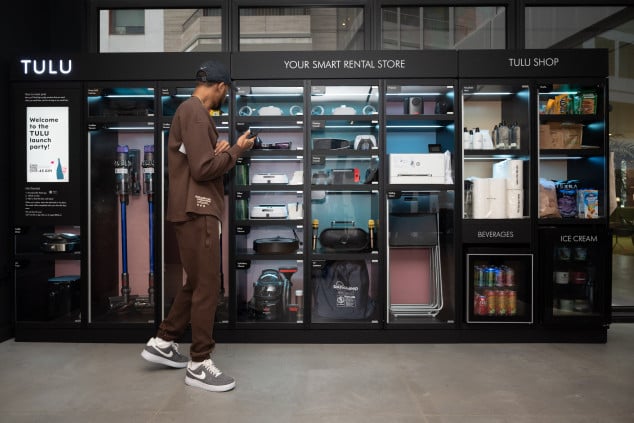
Renters can either pay per use or choose a monthly or annual TULU membership, which unlocks discounts.
TULU
Can the sharing economy help New Yorkers in tiny apartments with the problem of storing vacuum cleaners and other mundane but necessary household items? And are renters willing to pay a fee to borrow air fryers or upholstery cleaners—as opposed to owning them?
With Gen Z becoming a growing share of the rental population—and bringing their comfort with all things digital—those are the bets landlords at luxury rental buildings are making. Over 150 NYC buildings have installed kiosks from TULU, a NYC-based startup, as an amenity to draw renters. TULU gives renters on-demand access via an app to appliances and items for cleaning, cooking, beauty, hosting, DIY, and gaming, as well as convenience goods like snacks and toilet paper. Beyond NYC, TULU is in 60 cities in North America and Europe—500 buildings in total, according to the company.
If you’ve been apartment hunting, you may have already come across a TULU kiosk in a building lobby or online. Major property owners and managers partnering with TULU include Brookfield, Greystar, Brodsky, Related and RXR. Several mention TULU as an amenity on their websites, social media marketing, or StreetEasy building descriptions.
TULU is not the only household-goods-as-a-service provider in the U.S., but it appears to have limited competition in NYC. One exception is Caesura, a 128-unit rental building at 280 Ashland Pl., Brooklyn, which has a program called Common Goods that lends “a thoughtful selection of things you need occasionally but don’t really need to own.” The building has one unit on the market, a furnished studio available January 28th for $3,114 a month.
Last week, TULU announced an extension of its Series A funding round with a new $17 million investment that will enable it to add “hundreds of new buildings in NYC,” TULU CCO Yael Shemer told Brick Underground. The new funding round brings TULU's total Series A funding to $37 million.
Shemer co-founded the company with Yishai Lehavi after the two met at a business accelerator program at Massachusetts Institute of Technology. In 2019, the two launched TULU in NYC, where they thought it would be a great fit for apartment-style living, since it’s easier to borrow and return something if you’re only an elevator ride away.
Creating a framework for sharing
Sharing resources among people who live in close proximity is an ancient concept, said Shemer, who has a background in environmental science and urban design. She explained that TULU takes its name from tulou, large, 12th century Chinese compounds where people lived communally.
“We’re modernizing traditional solutions with a goal of sustainable consumption,” Shemer said. TULU’s main competitor is not another company, instead it is competing with “the buying mindset,” she said.
Shemer said TULU generally appeals to young renters who are likely to move again in two years and are reluctant to invest in a suite of appliances they use only once a week. You’ll find TULU primarily in luxury rental buildings, however some student housing, hotels, and office buildings have opted into the program.
The bar is higher for Gen Z
Young renters today generally “have financial means but they have small apartments,” Shemer said. They like name-brand goods “but can’t own them because of space constraints.” TULU features major brands like Dyson, Phillps, and Bosch, among others.
Average apartment sizes for new leases in NYC continue to slip even as rents remain near-record levels. Brooklyn’s median rent was $3,850 in October, up 6.9 percent from a year ago and the third-highest on record, according to the Elliman Report, which also noted that the average apartment size for Brooklyn rentals slipped for the seventh time.
The bar to becoming an owner is set much higher for Gen Z than previous generations and the answer isn’t to “stop buying lattes,” wrote Jonathan Miller, president and CEO of appraisal firm Miller Samuel and author of the Elliman Report in a recent newsletter.
“Despite younger generations earning more than their predecessors at the same age, homeownership hurdles today are far higher, reflecting a profound disconnect from the experiences of older generations who are doling out obsolete advice,” he said.
Renting household goods also ties into younger generations' well-documented preference for minimalism and mindful consumption. But this only works if there’s “an infrastructure for renting,” Shemer said. “You can’t just tell people to go rent products” if they’re not available, she added.
A developer expands with TULU
One major real estate developer is designing future products around TULU’s specifications. RXR currently has TULU kiosks in three Manhattan and three Brooklyn buildings with more to come thanks to a strategic partnership, Jarrod Whitaker, senior vice president of residential operations at RXR, told Brick.
As an amenity, TULU “gets great engagement” and “integrates well with our Class A” properties, Whitaker said. Renters like the convenience and the ability to reclaim closet space that would otherwise be used to store bulky vacuum cleaners, he added.
One RXR-developed building that has installed TULU kiosks is The Willoughby in Downtown Brooklyn. The development offers “hotel-level amenities,” including an impressive number of lounges for relaxing, gaming, work and hosting. There are 21 rental units currently available, including a studio for $3,596 a month.
TULU is a good fit for RXR’s “high-touch” personalized programming, Whitaker said. “As important as the physical buildings, it’s the service, touch, and delivery for a Class A hotel-like experience,” Whitaker said.
How TULU works
When TULU first launched, products were set up in a room, like on a basement level. The location has changed to a high-trafficked spaces, like the lobby, mailroom, or an amenity area. Renters gain access to items to rent or buy through the TULU app.
The structure is a wall system comprised of 20-inch modular columns and can be scaled to correspond with a building’s size. A 150-unit building would install four to six modules, while larger developments can add more modules and product variety. Every unit is stocked based on real-time data from TULU’s AI, which matches items to building’s demographics and usage patterns.
For example, buildings located far from stores would have more grocery and convenience items, student housing has more VR, gaming, and printer usage (residents can send documents from their phone or laptop to the kiosk’s printer), and pet-friendly buildings see more cleaning equipment.
TULU's pricing
Renters can either pay per use or choose a monthly or annual TULU membership, which unlocks discounts, offers, and building-specific perks. Prices vary by market and item, but most household products range between a few dollars per hour and flat daily rates.
Some items, like air mattresses, include 12 hours free to cover the user's needs but most items have a first-hour or multi-hour free periods.
Most popular TULU products
Initially, the company offered Dyson vacuums, chairs, laundry items, scooters, and household tools but the product selection has grown with a deeper assortment in cleaning appliances and hosting items, plus the addition of products for beauty and wellness, gaming, DIY, and e-scooters and bicycles—the latter are only in select locations.
The upholstery cleaner, for example, is “really popular with cat and dog owners,” Shemer said. Also popular are the Dyson hair wrap and Nintendo Switch consoles and virtual reality headsets.
Because the cleaning appliances are in heavy rotation, they are swapped out frequently for new ones. A vacuum cleaner that was designed for weekly household use may be rented a hundred times in a month.
Of all the items that TULU offers, vacuums cleaners remain the most popular. That’s because for today’s young renters, “we clean more than we host,” Shemer said.
You Might Also Like