




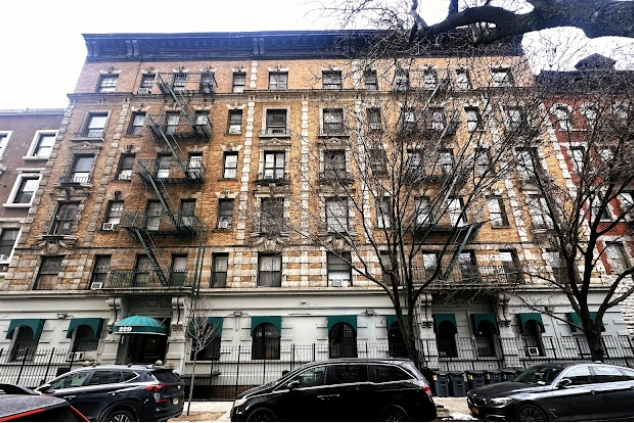
The Esperanto at 229 West 105th St: A dramatically wide tenement home to an accused arms broker
- Construction of the six-story tenement cost $125,000, about $4.45 million in 2026 dollars
- In 1919 resident Baron von Eglinitzki was arrested and sent to an internment camp

Rents in 1909 ranged from $660 to $840 per year, the equivalent of $1,950 to $2,500 per month today.
Anthony Bellow/The Daytonian
Have you ever passed by an interesting residential building in New York City and wanted to know more about its history? In this series, Brick Underground teams up with Tom Miller, creator of Daytonian in Manhattan, a blog about Manhattan buildings and other historic architecture. Each week, we will run an excerpt from the Daytonian’s archives with a link to the full article.
In 1908 developer Lorenz Weiher purchased five lots at 227-235 West 105th St. between Amsterdam Avenue and Broadway. He commissioned the architectural firm of Moore & Landsiedel to design a six-story brick-and-stone “tenement" on the site, as described in the firm's plans. (The term "tenement" at the time referred to any multi-family building.) Construction, which was completed the following year, cost Weiher $125,000, or about $4.45 million in 2026 dollars.
Moore & Landsiedel drew from colonial precedents, embellishing the brick-clad upper facade with dramatically splayed lintels and scrolled keystones, and prominent stone quoins (corner masonry blocks) to emphasize verticality in the extremely wide structure. The architects also broke up the horizontal plane by placing the entrance to the east and balancing its heavy stone enframement with a duplicate to the west, which framed two windows. The four-story midsection sat between intermediate cornices and the top floor was capped with a bracketed and corbelled cornice.

An advertisement for the Esperanto on August 15th, 1909 described "5 or 6 rooms and bath." Because financially comfortable New Yorkers fled the city in the summer months, the ad noted, "Concessions for summer." The advertised rents ranged from $660 to $840 per year, the equivalent of $1,950 to $2,500 per month today. Residents here were affluent enough to have domestic help.
Among its early residents were Baron Paul von Eglinitzki, a stockbroker who lived here following his divorce from the former Helen Nicholson in July 1915. Von Eglinitzki was born in Germany in 1876. The New York Times said that his ancestors "could be traced back to the fourteenth century" and that he "was for six years in the German Army, two years in the Thirteenth Huzzars and four in the first guard Field Artillery, of which the Kaiser was the Colonel."
On March 14th, 1919, The New York Times ran the headline, "Baron Paul von Zglinitzki [sic] and Others Sent to Fort Oglethorpe," and reported his arrest “after having been watched by Government secret agents for a year." The New York Herald explained that he was suspected "of having negotiated for the shipment of munitions in Mexico."
The baron and the other six German nationals were sent to an internment camp at Fort Oglethorpe, Georgia. But because the Armistice had been signed on November 11th, 1918, Von Zglinitzki was not there very long.
For more about 229 West 105th St. and its other colorful residents, check out the full article.
You Might Also Like