




Mayor Walker’s House at 6 St. Luke's Pl: Showgirls, corruption, and a $25,000 renovation
- 15 unusually wide and opulent brick-and-brownstone houses were built on this quirky block
- In this new series, Brick teams up with Tom Miller, creator of the Daytonian architecture blog

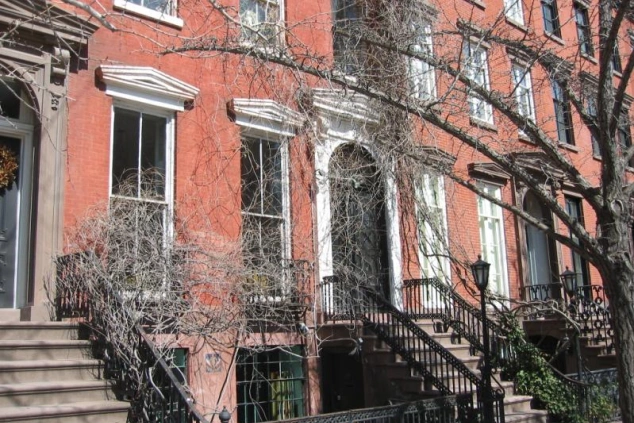
St. Luke’s Place is an odd location, even in quirky Greenwich Village. It is the name of the block where Leroy Street curves away from Seventh Avenue and meets Hudson Street.
Tom Miller/The Daytonian
Have you ever passed by an interesting residential building in New York City and wanted to know more about its history? In this new series, Brick Underground teams up with Tom Miller, the creator of Daytonian in Manhattan, a blog about Manhattan buildings and other historic architecture. Each week, we will run an excerpt from the Daytonian’s archives with a link to the full article.
This week is a look at 6 St. Luke’s Pl., once the home of New York City Mayor Jimmy Walker, a colorful figure who rose to office after serving in the New York State Assembly and State Senate.
St. Luke’s Pl. is an odd location, even in quirky Greenwich Village. It is the name of the block where Leroy Street curves away from Seventh Avenue and meets Hudson Street. After Hudson Street, it becomes Leroy again.
From 1851 to 1854, 15 nearly identical and unusually wide Italianate and Renaissance Revival brick-and-brownstone houses were built on this block. They featured opulent parlors, ornate plaster ceiling medallions and surrounds, and costly materials such as Italian marble and Honduras mahogany. Many boasted “triple-parlors,” with three rooms per floor.
Walker is described in Robert Caro’s “The Power Broker” as a fancy dresser, wearing a "pinch-waisted, one-button suit, slenderest of cravats, a shirt from a collection of hundreds, pearl-gray spats buttoned around silk-hosed ankles.”
But despite earning a reputation as a philanderer and a boozer, New York Governor Al Smith—a friend of his father—encouraged Walker to run for mayor in 1925. Walker won the race and decided his home on St. Luke’s Pl., now the mayoral residence, needed a $25,000 make-over.
For more about Walker’s home and his fall from public favor during the Depression, check out the full article.
You Might Also Like