




Mayor Grace’s house at 31 East 38th St: An expensive façade drew a series of prominent owners
- The Italianate-style granite-clad home displays architectural details fashionable for the era
- Wealthy businessman and mayor William Russell Grace purchased the house in 1880

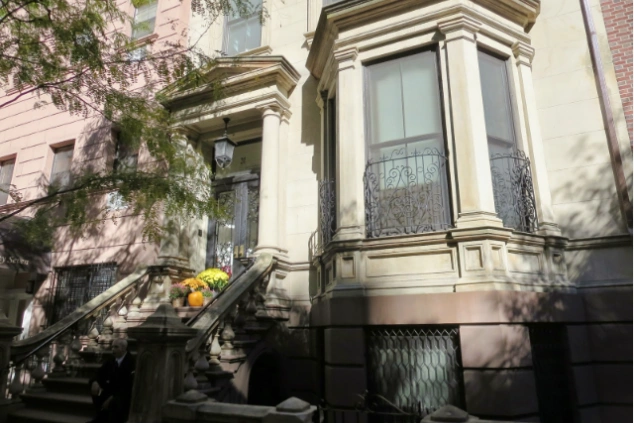
Expensive features include carved stone window surrounds and classical pediments.
Daytonian in Manhattan
Have you ever passed by an interesting residential building in New York City and wanted to know more about its history? In this new series, Brick Underground teams up with Tom Miller, creator of Daytonian in Manhattan, a blog about Manhattan buildings and other historic architecture. Each week, we will run an excerpt from the Daytonian’s archives with a link to the full article.
There were several status symbols coded into the architecture of 31 East 38th St. that indicated the wealth of its first owners, Thompson N. Hollister and his wife, M. Louisa Hollister. The family moved to the developing Murray Hill neighborhood just before the outbreak of the Civil War and the Italianate-style, granite-clad home was very fashionable for the era.
Expensive features include carved stone window surrounds and classical pediments. The entrance has a broad stoop with heavy stone Italianate newels and railings and is flanked by Doric columns on paneled stone blocks. A three-sided bay window mimics the entrance with Doric pilasters and carved panels.
In the late 1860s, the property became the home of merchant Philander Hall Butler and his family. He was likely responsible for adding the fashionable Second Empire mansard roof.
The wealthy businessman and newly elected mayor William Russell Grace purchased the house in 1880. Grace was the principal founder of the W. R. Grace & Company, initially a shipping business. In addition to his business income, Grace earned a yearly $10,000 stipend as mayor, about $235,000 today. He was the first Irish American Catholic mayor of the city (and was elected again 1884). In 1885, Grace accepted on behalf of the city the Statue of Liberty from the people of France.
It was tradition in NYC, stretching back to the Dutch colonial era, to install two lamps outside the mayor’s residence and Grace was closely involved with choosing his lamps. As The Evening World reported: “There stand at the foot of the broad steps leading up to his beautiful Berea granite residence at 31 East Thirty-eighth street, two stately beacons. The lamps have large spherical globes, held in frames of burnished bronze, on posts of bronze in graceful design.”
Mayor Grace’s lamps cost $326 and were the most expensive of all the mayoral lamps but are no longer in place. However the property and its handsome embellishments remain intact.
For more on Mayor Grace’s home and its other prominent owners, check out the full article.
You Might Also Like