



Your rental building is deteriorating and your landlord is headed toward foreclosure. How can you protect yourself?
- Organize with neighbors in your building, create a tenant union, and keep detailed records
- If your landlord defaults on their mortgage or is in foreclosure, your lease is still in effect
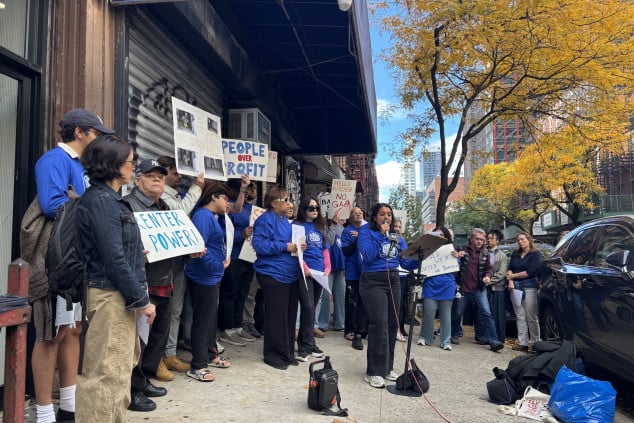
At a Nov. 7th news conference outside 408 West 56th St., tenants described deteriorating conditions inside their apartments.
Photo by Katy Lasell
No cooking gas for nearly two years. Frequent heat and hot water outages. Pest infestations. These were just a few of the signs of disrepair that pushed renters in 10 Hell’s Kitchen rental buildings—part of a portfolio of buildings in pre-foreclosure with $173.4 million in unpaid loans —to form the Haruvi-Hungerford Tenants’ Union.
At a Nov. 7th news conference outside 408 West 56th St., tenants described deteriorating conditions inside the apartments owned by Arthur Haruvi and managed by Peter Hungerford’s PH Realty. Peter Hungerford did not respond to a request for comment.
“The two years without cooking gas has had a big toll,” said Luis Pelaez, a resident of 408 West 56th St., according to a news release. “My family, and especially myself, like to cook during the holidays. We can’t cook Thanksgiving and Christmas meals on a hot plate.”
Andrew Timberg, a tenant organizer at Housing Conservation Coordinators, said in 10 of the 31 buildings, a majority of units are signed on to the tenant union. Tenant attorneys say forming a tenant union or association is one of the best ways to protect yourself if your building is at risk of going under.
So what else should you do if your building looks bound for foreclosure?
Before a foreclosure is final
First, it’s important to note that foreclosure can be a drawn out legal process, lasting up to 10 years.
“In New York, a mortgage lender generally must bring a foreclosure action in Supreme Court before it can obtain a foreclosure sale,” said Jennifer Rozen, managing attorney at the Rozen Law Group. Before that happens, an owner might miss mortgage payments or receive a default notice.
If your landlord defaults on their mortgage or is sued for foreclosure, that doesn’t mean your lease ends. Usually, a building owner is still responsible for operating the building, including making repairs and providing essential services, Rozen said. The exception is if the court appoints a receiver to collect rents (more on that below).
The protections of New York’s Good Cause eviction law still apply, said Altagracia Pierre-Outerbridge, attorney and founder of Outerbridge Law and a Brick sponsor. If your unit is rent stabilized, it doesn’t lose that designation.
You’ll have at least 90 days in your apartment or until the end of your lease—whichever is longer—to vacate if your apartment is market rent. Even if your lease is month-to-month, you still get 90 days to move out, Pierre-Outerbridge said.
What a foreclosure changes for tenants
Generally, a lot changes after foreclosure, which means uncertainty for tenants.
“If the buildings go up for auction, it means that there’s going to be a new owner. In the worst case that means a speculative corporate landlord takes over the buildings and runs them on a shoestring budget and continues the irresponsible management of the buildings,” Timberg said.
On the other hand, tenants might be able to get a say in the next owner or the ability to negotiate conditions for the building sale. “It can also be an opportunity for tenants to influence the future of their buildings and potentially bring in a better owner,” Timberg said.
For tenants in 93 buildings owned by the bankrupt Pinnacle Group, pressure from the Union of Pinnacle Tenants and support of the mayor led to the properties’ buyer agreeing to a plan to remedy serious violations and invest in repairs.
When the Community Opportunity to Purchase Act goes into effect next year, community land trusts and other qualified nonprofit buyers will have the first shot at making an offer to buy multifamily buildings that meet certain conditions.
Signs your building might be in financial distress
Deteriorating conditions may indicate that something’s not right with the financial health of your building.
Repeatedly postponed repairs, recurring heat or hot water outages, trash piling up, or contractors not receiving payment are all signs that your property’s owner could be underwater financially. Receiving a utility shutoff notice or not being able to contact your management company or landlord might signal that something is amiss, Rozen said.
“The easiest way to suss out the ownership status and financial status of the building is to figure out who the landlord really is,” Timberg said.
If you don’t know who actually owns your building, Who Owns What in NYC from the nonprofit JustFix can help you find the name of the actual landlord, since many buildings hide behind "shell" companies. Other sources include ACRIS property records, New York City Department of Finance tax records and state court records.
Pulling up the landlord’s name or companies in the New York State Courts Electronic Filing System could yield lawsuits from contractors who haven’t been paid or disputes with lending agencies, another clue of financial problems.
How to protect yourself if your building is going under
In addition to doing your research, the best ways to protect yourself are to keep good records, talk to your neighbors and pay attention to where you’re sending your rent payments.
If a receiver is appointed in a foreclosure case, you may receive a notice telling you to send your rent to someone other than your landlord. It’s a good idea to search for the foreclosure case to see any orders and make sure your money is going to the right person, Rozen said.
“The tenants can ask the receiver to make repairs—heat, hot water,” Pierre-Outerbridge said. “The point of the receiver is to make sure the landlord isn’t pocketing the rent as the foreclosure is going on.”
Documents to hold onto include leases, renewals, records of security deposits, proof that you paid your rent and any communications with the landlord, Rozen said. You should maintain your own copies of these items outside of your landlord’s online portal. To keep track of poor conditions preserve dated photos, written repair requests, and any 311 complaints you file.
Form a tenant association or union
Getting your neighbors together strengthens your ability to resolve issues, and can help you bargain with your landlord or a new owner as a group.
You don’t need your landlord’s permission to form a tenant association. While the law doesn’t compel him or her to acknowledge your organization, there are legal protections against retaliation or harassment from your landlord for organizing with your neighbors.
“The number one thing you can do is talk with your neighbors, establish a form of group communication, and document any issues that are occurring in the building,” Timberg said. In addition to documenting issues with photos, it’s also important to report any issues to 311, Timberg said.
A group of tenants can bring what’s called Housing Part action to force a landlord to address repairs. In the case of seriously dangerous conditions, tenants can file a 7A complaint, which can result in an HPD-approved administrator taking over to deal with conditions that threaten tenants’ health and safety.
You Might Also Like