




NYC Door & Lock Laws: Requirements & Tenant Rights
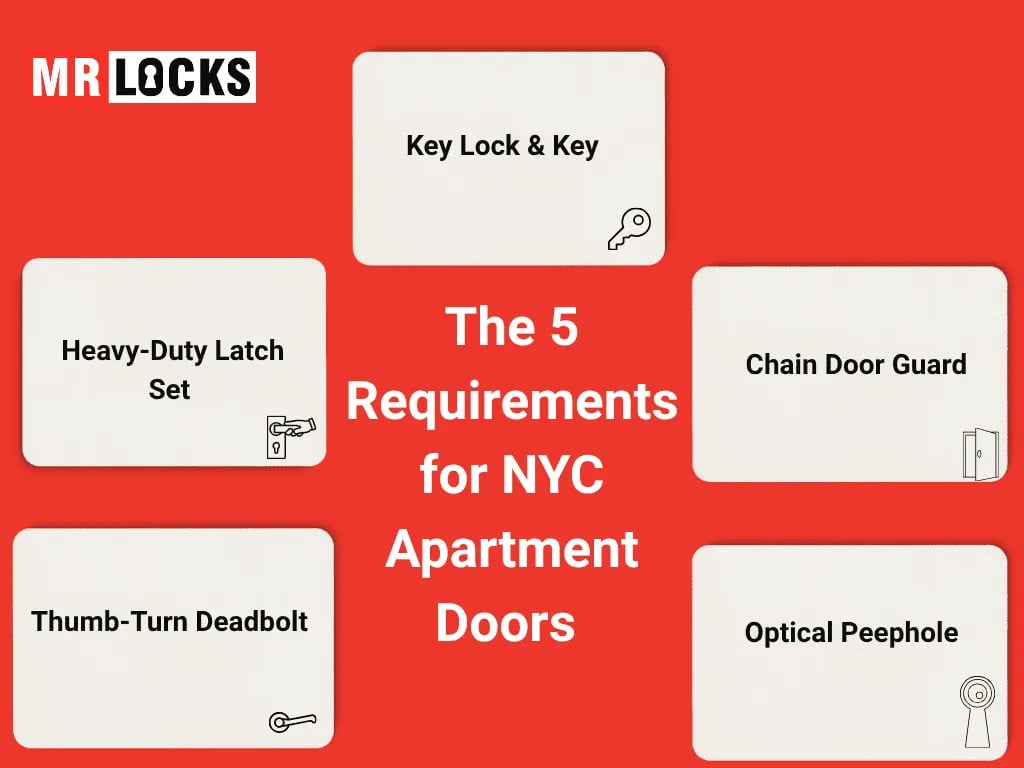
- All NYC Apartments are required to have key lock, latch set, deadbolt, chain lock, and peephole
- You are legally allowed to install another lock of your own as long as it is less than 3 inches and you provide your landlord a key
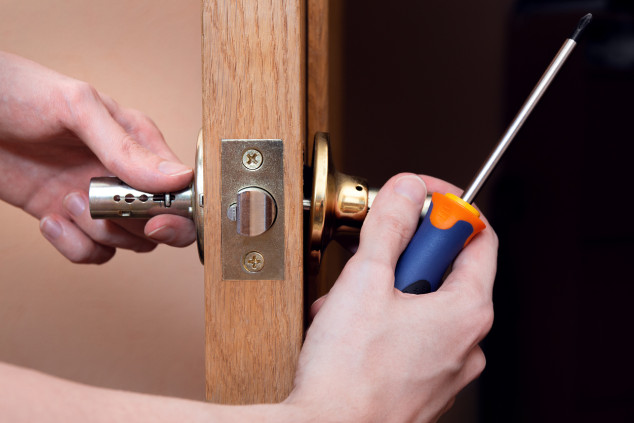
Mr. Locks has 24 hour emergency locksmith services available every day to residential and commercial clients throughout New York City, including Manhattan, Queens, Brooklyn, the Bronx and Staten Island.
iStock Photos
Laws… They aren’t exactly fun to discuss.
But you can bet laws are at the core of every big decision we make.
Renting a property, whether you’re the landlord or the tenant, is a major milestone, and it’s one you need to be fully prepared for.
Especially if your real estate is in NYC.
Few things carry as much legal weight or have such a large impact on your comfort as the physical security of the front door. NYC apartment door and lock requirements are among the strictest in the nation. Between city housing codes, state statutes, and strict fire safety mandates, keeping a building compliant and a tenant safe requires knowing exactly what hardware needs to be on that door.
This is why, at Mr Locks, we have dressed ourselves as friendly legal researchers and brought to you the guide to NYC Apartment Door and Lock Laws.
The 5 Basic Hardware Requirements for NYC Apartment Doors
Doors are just doors, right? Well, not really. For your average entry door of an NYC residential place, you won’t want to put on whatever lock you found on sale at Amazon.
New York City housing codes treat front door security as a matter of strict legal compliance and life safety. If you install non-compliant hardware, you could be looking at immediate housing violations, invalid lease terms, or serious fire safety hazards.
According to the NYC Housing Maintenance Code (HMC) § 27-2043 and § 27-2041, building owners of Class A multiple dwellings (standard residential apartment buildings) are legally required to equip every apartment entry door with five essential items:
1. Key Lock & Landlord-Provided Key
Under HMC § 27-2043(a), the building owner must supply a primary key-operated lock on the entrance door and hand over at least one working key to the tenant at move-in. While one key is the legal minimum, landlords can provide extras for roommates or family members.
2. Heavy-Duty Latch Set
Also mandated by HMC § 27-2043(a), this is the main handle or doorknob mechanism that catches the strike plate. It ensures the door stays firmly seated and latched in its frame during normal daily use, without requiring you to turn a key or throw a bolt every single time the door swings shut.
3. Heavy-Duty Deadbolt (Keyed Outside, Thumb-Turn Inside)
This is your primary defensive barrier. HMC § 27-2043(a) strictly requires a deadbolt that opens with a physical key from the hallway, but must be operated by a simple thumb-turn from the inside.
The Legal & Safety Rule: Installing a double-cylinder deadbolt (a lock requiring a key to exit from the inside) on an NYC residential door is 100% illegal. In a dark or smoke-filled emergency, searching for a key to get out of your own apartment can be fatal. If an HPD auditor or FDNY inspector spots a double-cylinder deadbolt, it triggers an immediate violation.
4. Chain Door Guard
Under HMC § 27-2043(b), every entrance door must have a sturdy chain door guard or slide-bar latch. This gives tenants the ability to crack the door open a couple of inches to safely inspect or talk to a caller without fully opening the apartment to the hallway.
5. Peephole / Door Viewer
According to HMC § 27-2041, building owners are required to install and maintain an optical door viewer (peephole) at eye level in every apartment entrance door so residents can clearly view visitors standing outside before opening up. There are, however, some exceptions to bear in mind (Dorms, hotels, apartment hotels, and owner-occupied 1- to 2-family homes).
The Self-Closing Door Law
If there is one thing NYC housing inspectors and the fire department are super focused on right now, it’s self-closing doors.
You might think a door that stays propped open or stops an inch short of latching is just a minor annoyance. But in the eyes of New York City, it is a life-or-death fire safety issue, and the rules around it are strictly enforced.
The Rule
Every single apartment entry door and hallway fire door in buildings with 3 or more apartments must swing completely shut and latch automatically all by itself. No pulling it shut behind you, no giving it an extra nudge, and definitely no propping it open with a shoe or a kick-down stop.
Why Enforcement Is at an All-Time High
Following tragic multi-family fires in recent years, the city doubled down on door safety. Local Law 71 was passed, creating dedicated inspection programs where HPD (Housing Preservation and Development) inspectors randomly audit hundreds of residential buildings every year, testing doors floor by floor.
The idea isn’t that complicated: if a fire breaks out inside an apartment, a self-closing door keeps the flames and toxic smoke trapped inside that unit rather than letting it spill out into hallways and stairwells, giving everyone else in the building a safe path to escape.
See why it’s important now?
The Penalties for Landlords
NYC takes broken closers so seriously that HPD categorizes a defective self-closing door as a Class C “Immediately Hazardous” violation.
- Short Fix Window: Landlords get just 14 days to fix it and certify the repair.
- Costly Penalties: If it isn’t fixed in time, fines start at $250 to $500, plus an extra $250 per day until the violation is resolved.
- City Repairs: If a landlord ignores it, HPD can send its own emergency contractors to fix the door and slap the bill directly onto the property taxes.
The 10-Second Self-Test
Whether you’re a landlord staying ahead of inspections or a tenant checking your own home, testing your door takes 10 seconds:
- Open the door fully (about 90 degrees).
- Let go (don’t push or pull it).
- Watch it swing shut: It must close smoothly, catch the strike plate, and click completely latched on its own.
If it stops short, pops back open, or requires you to manually pull it to hear that “click,” the closer mechanism, hinges, or latch needs immediate adjustment.
Building Entrance & Intercom Laws
So far, we’ve talked about your apartment’s immediate front door.
But what about the front gate of the fortress, also known as the main lobby entrance?
New York State takes building-wide security just as seriously. Under Section 50-a of the NY Multiple Dwelling Law, the city requires property owners to secure the main entry points to keep uninvited visitors out and give residents complete control over who gets in.
1. Automatic Self-Locking Main Entrances
For any apartment building (Class A multiple dwelling) constructed or converted after January 1, 1968, every main street entrance, courtyard door, and cellar access point must be equipped with automatic self-closing and self-locking doors.
- The Rule: These front lobby doors must remain securely locked 24/7, unless there is an actual building attendant or doorman on active duty.
- Older Buildings: What happens with pre-1968 buildings? If a simple majority (over 50%) of the tenants request it in writing, the landlord is legally required to install self-locking front doors and an intercom system.
2. Intercom & Voice Communication Systems
In buildings with 8 or more apartment units, a locked front door isn’t enough on its own; residents need a way to screen visitors.
The law requires a working two-way intercommunication system right at the main entrance.
- Two-Way Audio: You must be able to speak clearly with whoever is standing outside the main lobby door directly from your apartment.
- Remote Buzz-In: The system must include a remote release mechanism so you can unlock the main front door for guests or delivery drivers without having to walk down to the lobby.
3. Roof Doors: Emergency Escape Over Security
While the front lobby is designed to keep people out, roof doors are designed to let residents out in a life-threatening emergency.
- Self-Closing, NOT Self-Locking: Every door leading to the roof must be self-closing, but it cannot be self-locking from the roof side.
- No Keys Required: The lock or latch on the inside must be operable via a simple push bar, lever, or movable bolt, never a key. If tenants need to escape a hallway fire by running up to the roof, no one should be trapped searching for a key to push the door open.
Tenant Rights: Adding Your Own Locks vs. Smart Locks
Tenants reading this, heads up: this matters whether you’re planning to rent a new place or just want to give your front door security a serious upgrade.
If you’ve been the unfortunate victim of a break-in, feel a bit suspicious about who might have a key from prior leases, or would simply feel much more at ease living with an extra layer of protection, New York law is firmly on your side.
Under New York Multiple Dwelling Law § 51-c, renters have explicit legal protections when it comes to securing their own front doors.
The Extra Lock Rule (§ 51-c)
The state of New York gives you the unconditional legal right to install one extra lock on your apartment entrance door, separate from the primary lock provided and maintained by your landlord.
- Size Restriction: The lock mechanism cannot exceed 3 inches in circumference.
- Lease Restrictions Voided: Landlords cannot fine you or penalize you for exercising this right. Any clause written into a residential lease attempting to prohibit you from installing an extra lock, or charging you a fee for doing so, is legally null and void.
The Key Provision: You Must Hand Over a Copy
While you have the right to add a lock, you don’t have the right to lock your landlord out entirely.
The law clearly states that you must supply a duplicate key to the landlord or managing agent upon request. Landlords retain the legal right to access the apartment for emergency situations (like a burst pipe, gas leak, or fire) and scheduled maintenance. Keeping the only key to yourself puts you in breach of the law.
Can You Install a Smart Lock or Keyless Entry?
Yes, but with a few caveats:
- Board & Lease Rules Apply: Smart locks often replace the outer escutcheon plate or handle entirely, which can trigger building aesthetic guidelines, especially in co-ops, condos, or historic landmark buildings.
- Emergency Access Duty Still Stands: If you install a keypad, Bluetooth, or smart lock, management still needs emergency access. This means providing them with a master PIN code, digital access rights, or installing a smart lock model that retains a physical key cylinder so you can give them a standard backup key.
Rekeying vs. Replacing
If your main goal is just feeling safer after moving in, rekeying your lock cylinder is almost always better than replacing the entire lock set.
When a locksmith rekeys a door, we change the internal pins inside the existing cylinder so old keys stop working immediately, while the external hardware stays untouched. It’s fast, cost-effective, preserves the door’s original appearance, and keeps you 100% compliant with building codes, as long as you hand that freshly cut key to management.
Need Help Bringing Your NYC Apartment Doors Up to Code?
Figuring out NYC’s lock and door regulations doesn’t have to be overwhelming. It doesn’t matter if you’re a tenant wanting an extra layer of security, a buyer moving into a new apartment, or a landlord needing to resolve an HPD self-closing door violation before fines kick in, the team at Mr. Locks has you covered.
Call Mr. Locks 24/7 at 212-780-0144 or visit our showroom at 400 2nd Ave, New York, NY 10010 to speak directly with our team.
Frequently Asked Questions (FAQ)
What locks are legally required on an NYC apartment door?
Under NYC Housing Maintenance Code § 27-2043 and § 27-2041, every apartment entrance door in a Class A multiple dwelling must have five specific hardware items: a primary key lock (with at least one key provided by the landlord), a heavy-duty latch set, a heavy-duty deadbolt, a chain door guard, and an eye-level optical peephole.
Is a double-cylinder deadbolt (keyed inside and outside) legal in NYC?
No. Double-cylinder deadbolts that require a physical key to unlock from the inside are 100% illegal on residential apartment doors in New York City. Fire codes mandate that the interior deadbolt mechanism must operate using a simple thumb-turn so occupants can immediately escape during a fire without searching for a key.
Can a tenant in NYC add their own lock to the front door?
Yes. Under New York Multiple Dwelling Law § 51-c, NYC tenants have the unconditional legal right to install one extra lock (up to 3 inches in circumference) separate from the landlord’s lock. Lease clauses that attempt to ban secondary locks or charge a fee for them are legally void. However, the tenant must provide a duplicate key to the landlord or managing agent upon request.
Who is responsible for fixing a broken self-closing door in an NYC apartment?
The building owner or landlord is legally responsible for maintaining self-closing door mechanisms under NYC Housing Maintenance Code § 27-2041.1. If an apartment door or hallway fire door fails to shut and latch automatically, HPD treats it as a Class C “Immediately Hazardous” violation, giving the landlord 14 days to complete repairs before daily fines begin.
Can NYC landlords charge a fee if I install a secondary lock?
No. Under NY Multiple Dwelling Law § 51-c, any clause in a residential lease agreement charging a tenant a fee or extra rent for installing an additional lock is illegal and unenforceable under New York state law.


