




How much does moving to the suburbs cost vs. staying in NYC?
- Real estate prices in the suburbs can be as much as 25 to 50 percent cheaper than in the city
- Property taxes are much steeper on average, but you won't have to pay NYC's high income tax

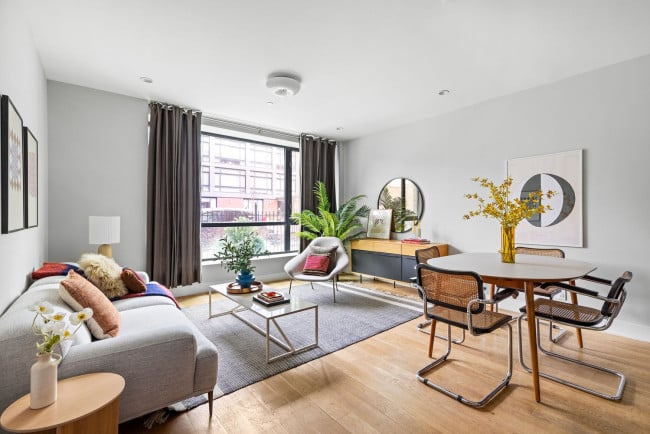
This three-bedroom duplex condo in Williamsburg is listed for $1.8 million, or $1,384 per square foot—almost triple the median price per square foot in Montclair.
Figuring out whether to move to the suburbs or stay in New York City has long been a point of debate for families—traditionally centered on housing costs, commute times, and lifestyle preferences. But in recent months the conversation has shifted.
“It’s still an incredibly personal decision and absolutely not one-size-fits-all,” said Jennifer Ross, a Westchester-based broker at Compass who has helped dozens of New Yorkers relocate over the past decade. “But the reasons people are moving today are different. It’s less about escape and more about designing the lifestyle they want for the next 10 years—space, community, schools, and balance.”
Below is a look at the real costs and trade-offs of moving to the NYC suburbs.
[Editor's note: An earlier version of this post was published in December 2022. We are presenting it with updated information for November 2025.]
1) Prices in the suburbs have risen sharply
You’ll still get more bang for your buck in the suburbs, but pricing there has climbed dramatically since the early 2020s.
“The $800,000 to $900,000 range is no longer the sweet spot it once was in lower Westchester," Ross said. "That used to get you a move-in-ready home; now it’s often the entry point for something smaller or needing updates.”
She noted that inventory remains historically low, keeping pricing elevated across nearly all commuter towns.
“Entry-level turnkey colonials in Larchmont, Scarsdale, or Bronxville are typically ranging from $1.4 million to well above $2 million,” Ross said. “Even in more mid-market towns like Pleasantville, Tuckahoe, White Plains, and Mamaroneck, competitive homes are regularly selling between $1.1 million and $1.4 million.” More substantial properties will be priced (much) higher.
By comparison, Manhattan's average sales price is $2,098,658 and in Brooklyn, the average sales price reached $1,388,463, according to the Elliman Report for the third quarter of 2025.
“Families tell me: ‘If we’re going to spend this much money, we want room to actually live.’ And suburban homes deliver on that more consistently,” Ross said.
When it comes to square footage, Shawn Elliott, a broker at NestSeekers International, said the suburbs win out every time. "You can get double the square footage in the suburbs for half the price of the city," he noted, putting the savings between 25 and 50 percent if you buy in the suburbs versus the city.
"On Long Island, you could easily find something that goes for under $600 per square foot," he said—adding that the suburban houses he's selling are typically on multiple acres and have tennis courts, pools, wine cellars, and garages. (The average price per square foot in Manhattan was $1,552 in the third quarter, as per the Elliman Report.)
2) Maintenance costs remain part of the trade-off
While more square footage is the number-one draw, it comes with increased upkeep.
What's more, “You’re trading the convenience of a super for the freedom of a backyard,” Ross said. “And that comes with responsibilities.”
She always advises buyers to build a maintenance cushion into their yearly budget, estimating that most clients budget $8,000 to $15,000 a year for lawn care, HVAC servicing, snow removal, gutter cleaning, and the myriad repairs that come with homeownership.
In a large, suburban single-family house, utilities will also cost more, as will all the additional furniture, home decor, lighting, and fixtures you'll need. That can add up to tens of thousands of dollars.
3) Suburban living requires the costs of car ownership
Transportation remains one of the most significant adjustments for city dwellers.
According to AAA's 2025 analysis, the total cost of owning and operating a new vehicle is currently $11,577, or $965 per month. So if you plan on going from zero cars to two, the numbers add up fast.
You'll need to budget for auto insurance as well—at an average of $341 monthly for full coverage. On a bright note, the premiums are generally cheaper in the suburbs. For example, Bankrate shows $232 as the average cost of full-service coverage in Chappaqua, compared to $565 in Brooklyn.
Of course, many New Yorkers already own a car, shelling out $500 to $600 per month for parking garages. “When they move, that garage expense simply shifts into other budget categories. You’re not saving the money, but you are reallocating it," Ross said.
She also noted that not every suburb requires two cars. “Walkability is huge in 2025. Larchmont, Pelham, Hastings-on-Hudson, Dobbs Ferry, Pleasantville, and Tarrytown continue to be great options for people who want a village lifestyle where you can walk to town, the train, coffee shops, parks, and schools.”
Walkable neighborhoods in New Jersey include Montclair, Maplewood, Summit, and Chatham, while Greenwich and Westport are good options in Connecticut.
4) The commute could be more expensive from the suburbs
Are you required to work in person? If so, it's worth considering the added travel cost and time when contemplating a move.
An 80-mile round trip from Westchester to Manhattan will cost more than $1,300 per month for gas if you choose to drive alone. Monthly costs for taking Metro-North will be closer to $150, depending on where you live and how often you commute. And thanks to work-from-home flexibility, these commuting costs may be significantly lower.
5) Taxes point in both directions
Property taxes are higher in the suburbs: In NYC, the average effective tax rate is less than 1 percent, calculated by dividing your total tax by your taxable income. In the suburbs, the average effective tax rate is often above 2 percent, though it can vary widely by state and school district.
On the flip side, moving outside NYC means no longer paying city income taxes. Depending on your income and tax bracket, the savings can be substantial—as in more than $30,000 if you earn $800,000 a year.
6) Home insurance can be more expensive in the suburbs
The average cost of homeowners' insurance in the suburbs typically ranges from $1,200 to over $3,000 annually, with rates varying widely by county and coverage levels. Rates in suburban areas are generally lower than those in NYC proper, but factors such as proximity to the coast can raise them. For example, Westchester County averages around $1,800 per year, whereas Suffolk County on Long Island exceeds $3,000.
The ultimate takeaway is to factor this cost into your initial buying calculation, following the same rule of thumb for both the city and the suburbs: The sum of your mortgage payment, property taxes, and insurance premiums should not exceed 30 percent of your annual income.
7) The cost of raising a family can be lower overall
Education often becomes the deciding factor—and one of the biggest financial wins.
According to Ross, public school quality is still the top driver in Westchester—especially for those who were considering private school in Manhattan, where tuition now averages $55,000 to $65,000 per year, per child. That adds up quickly.
“I’ve had clients accept a $60,000 to $80,000 property tax bill with zero hesitation because they’re no longer paying $150,000 in private school tuition for their three kids,” Ross said. “It’s simple math—and it’s compelling.”
Suburban extracurriculars are not only less expensive but also more accessible, with much less competition for sports, music, clubs, and all the rest. “Parents love that. Their kids get to explore without the stress of waitlists and lotteries,” she added.
The upshot
Ultimately, the decision is deeply personal—but much clearer when framed in terms of lifestyle, not just cost. “It’s about building the life you want for the next decade,” Ross said. “For many families, the suburbs feel like the right place to do that.”
—Earlier versions of this article contained reporting and writing by Emily Myers. It was updated for November 2025 by Evelyn Battaglia.
You Might Also Like