



We want to buy a Brooklyn townhouse under $2 million. Should we consider a one- or two-family?
- In several Brooklyn destinations, many single-family homes have been converted to two-family
- Your decision also depends on your comfort level with sharing a property with a tenant

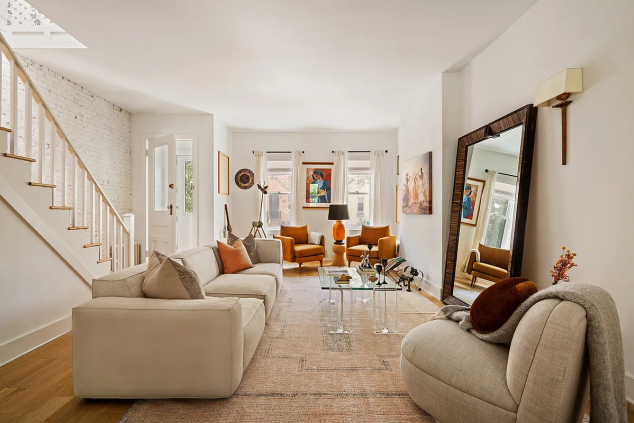
A two-family at 213 29th St. in Greenwood has a renovated three-bedroom owner’s duplex, one-bedroom garden apartment, and landscaped backyard. It is asking $1.995 million.
We’re in the market for a Brooklyn townhouse under $2 million, but we’re not sure if we should stretch our budget for a two-family house or maximize our living space and privacy with a single family. Is it worth the investment to be a landlord these days? Which type of house is better for resale?
Your search for Brooklyn townhouse sales with a limit of $2 million undoubtedly turned up listings for both one- and two-family townhouses. Deciding which way to go will depend on the neighborhood as well as your comfort level with sharing a property with a tenant, which means you’ll be more accessible than a landlord who lives elsewhere, Brooklyn brokers told Brick.
And even though $2 million may seem like a lot of money, in the Brooklyn townhouse market you’re not likely to get everything on your wish list, and that can be a bitter pill. Here’s more on what you should consider.

Limited inventory means compromises
In certain Brooklyn neighborhoods, such as Bedford-Stuyvesant, Crown Heights, and Winsdor Terrace, many properties that were originally built as single-family homes have been converted to two-family to generate income.
You may be eyeing an area that has a high percentage of townhouses under $2 million, “but if you insist on a single-family you may not get the neighborhood you want,” said Danielle Nazinitsky, an agent at Decode Real Estate. She suggested buyers who want single-family townhouses for that price should check out Gowanus and Greenpoint.
Want the cake and eat it too
In the $2 million and under range, you also may have to compromise on the configuration. If you had visions of tending plants or hosting parties in your own backyard, be aware that for older conversions, the rental unit is typically the garden unit and the owner duplex is above.
The lower level can be less desirable, since it gets less light, and some buyers may not want to live with their tenants walking above them.
Still, higher mortgage rates are making buyers “pickier” about layouts. Since buyers are paying so much, “they want the rental income and the backyard,” Nazinitsky said.
Inventory for houses was down in Brooklyn in the third quarter with 17.3 percent fewer properties on the market compared to a year ago, according to Compass’s recent sales market report. The median sales price for houses was $1,699,000, a 1.1 percent increase from a year ago.
On the flip side, a rental unit with outdoor space means you can ask for a higher rent. Nazinitsky said that in a townhouse on St. Marks Avenue in Crown Heights, an 800-square-foot, two bedroom, two bath with central air and a small outdoor space recently rented for $4,000.
'Don’t want to tiptoe'
Nazinitsky used to own a Bed-Stuy townhouse, where she lived for a time in the upper unit (she has since sold the property to her tenants). Privacy and noise are big issues for on-site owners, she said. She’s had some clients put soundproofing between the floors because “they don’t want to have to tiptoe.”
Otherwise, noise from a television or even a loud conversation can easily travel between floors. When she rented out her upstairs unit, she instituted a floor-covering rule similar to what you find in many NYC co-op buildings.
Your responsibilities as an owner and landlord
If it’s your first time as a landlord and as a townhouse owner, you’ll need to get up to speed quickly on your responsibilities.
It’s on you to maintain your heating and cooling systems, plumbing, roof, gutters, yard, and sidewalk—or hire someone to handle maintenance for you. You’ll need to keep your property pest-free and shovel snow too. New rules about property disclosure statements will give you a sense of the age of your mechanicals and roof.
Getting ahead of flooding will be an imperative, as global warming increases the frequency and severity of extreme weather. Nazinitsky put $20,000 into her basement after a flood, she said.
“Anyone that says their basement hasn’t flooded isn’t telling the truth. A lot of owners put up with flooding and it’s horrifying to buyers. They make a huge investment and get a basement filled with water,” she said.
Because this is your home too, you’ll notice when something needs repair or replacement—like an entryway light fixture with a dim bulb or a cracked sidewalk. But you face more accountability as a landlord.
“When you own and something is broken, sometimes you can wait to fix it,” Nazinitsky said. “You’ll need to fix things right away for a tenant.” After all, they can easily knock on your door.


Finding a tenant for your townhouse
For two-family owners who are renting out the other unit, “you have to do a good job of vetting the tenant,” said Tali Berzak, a broker at Compass. It’s a good idea to talk to prospective tenants yourself—but ask your broker to go over what you can and cannot discuss so you avoid breaking any Fair Housing rules, she said.
Setting the rent correctly is key “so you have multiple candidates to choose from,” Berzak said.
While Brooklyn median rent is at record levels, and you’ll likely be eager to get some help with your mortgage, keep in mind how a townhouse rental stacks up with the competition. On the one hand, for a typical 20-by-40-foot townhouse, the rental unit is likely 750 square feet—which can be larger than a typical one-bedroom rental in a new development.
But on the other hand, a townhouse is going not going to be able to compete with a new rental building with a pool, gym, and other amenities.
Still, new developments are typically in busy areas, and many renters like the quiet of tree-lined, residential Brooklyn side street, Berzak said.
Kemdi Anosike, an agent at Compass, said townhouse living appeals to many Gen Z renters. Thanks to TikTok videos, “they are looking for charm rather than a box in the sky.”
Even so, as a townhouse buyer, you will have a tough time finding all three key ingredients: the right location, configuration, and width—a wider building will command more for the rental unit. It’s a big concern to buyers looking for all three factors to maximize their investment, Anosike said.
Keeping an open mind
Elizabeth Kohen and Paul Paglia, brokers and co-owners of Brooklyn-based Garfield Realty, each took a different approach to townhouse living when they became owners.
Kohen wanted a two-family “mostly to offset the mortgage.” She wanted the flexibility to be able to have her in-laws living downstairs or expand her own living space in the future.
She said she enjoys having tenants. “Do I hear the front door opening? Yes, but I like the feeling of life in my house,” she said. She also appreciates knowing that they are around when she is out of town.
In Paglia’s case, he wanted a single-family townhouse.
“When I bought my house, we had small kids and a dog. The only noise I wanted to hear was our own. After living in rental apartments, I didn’t want a tenant below or above me, I wanted it to be completely ours, with sole use of the backyard,” he said.
Limited inventory and bidding wars
Still, it helps to be flexible as a buyer. Paglia recently worked with buyers who were looking for a single family in Brooklyn but getting outbid. They then found a two-family and were able to buy it with help from their parents—who gave up their own pied-à-terre to live with them.
Kohen pointed out that with few townhouses being built today in NYC, this type of housing is more unique and appreciates more rapidly than co-ops or condos.
“You generally want to hold onto to an apartment for five to seven years, but a house can appreciate in value in three years,” she said.
Tight inventory also means bidding wars.
“It’s all about location and potential, Kohen said. “We’re seeing a lot of bidding wars because of a lack of inventory related to high mortgage rates.” The lock-in effect means owners are reluctant to sell if it means they have to borrow at today’s rates to buy somewhere else.
She said 70 people lined up to see a house in Windsor Terrace that was listed for $2 million. It ended up selling for $2.4 million.
Quick tips from brokers
Buying a two-family house offers opportunities for buyers to be strategic. Here are some additional tips from brokers.
- Market the rental before you close on the property. You can get the security deposit and first month’s rent before you write out some big checks.
- Gain peace of mind by requiring renters to get a personal or institutional lease guarantor.
- If you’re using a two-family as a single-family, leave the C of O as is. It can’t be reversed.
- If you don’t want the day-to-day responsibilities of being a landlord, consider getting qualified as a short-term rental host or use the second unit for when family members visit. You’re not obligated to rent out the second unit.
- Your rental income can help offset your mortgage payments. But if you are getting a conventional loan and you don’t have a history of being a landlord, Fannie Mae only allows you to apply the property’s monthly mortgage payment to qualify.
You Might Also Like