



The 1861 Pettibone House at 124 East 10th St: A former boarding house with a notable designer
- Historians attribute the rowhouse to James Renwick, Jr., designer of nearby Grace Church
- After the death of her husband in 1863 Henrietta A. Pettibone took in ‘respectable’ boarders

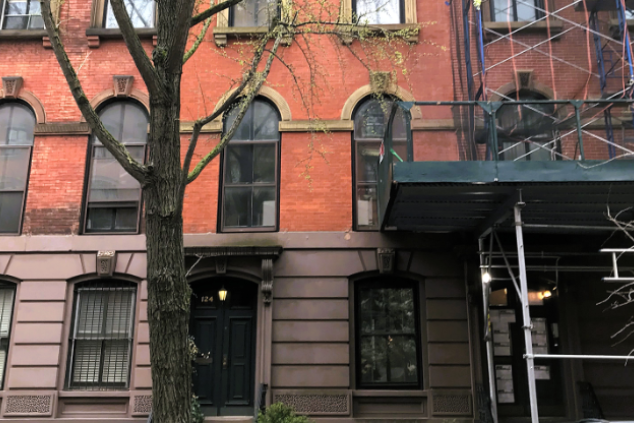
In 1976, the property was renovated into a two-family home. The exterior survives nearly unchanged since its completion in 1861.
Have you ever passed by an interesting residential building in New York City and wanted to know more about its history? In this series, Brick Underground teams up with Tom Miller, creator of Daytonian in Manhattan, a blog about Manhattan buildings and other historic architecture. Each week, we run an excerpt from the Daytonian’s archives with a link to the full article.
In 1651, Peter Stuyvesant established two farms far north of New Amsterdam. The lane that separated Bouwerij #1 and #2 would eventually become Stuyvesant Street. When East 10th Street (part of the rigid street grid of the 1811 Commissioners Plan) was opened in 1826, the diagonally running Stuyvesant Street created an odd-shaped parcel, the triangular point of which Elizabeth Stuyvesant retained as her garden. Four years after Elizabeth's death on September 16th, 1854, Matthias Banta purchased the point for development.
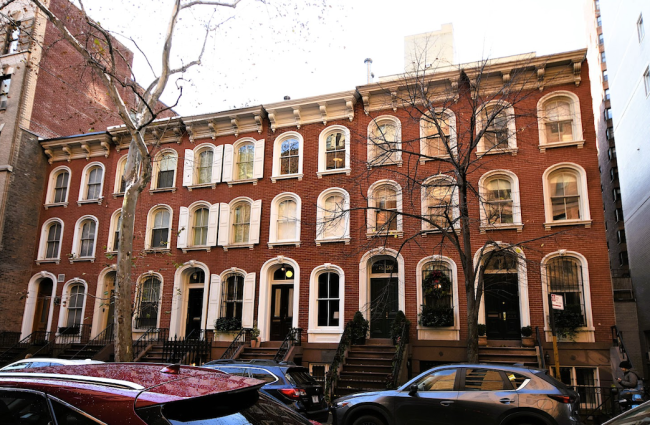
Most historians attribute the resultant rowhouses to James Renwick, Jr., who had designed the magnificent Grace Church about three blocks to the west in 1846. Completed in 1861, the Anglo-Italianate, five-story-and-basement homes varied from 16- to 32-feet-wide and (because of the triangular plot), their depths ranged from 16- to 48-feet.
Like its neighbors, the rusticated brownstone basement and first floors of 192 10th St. (renumbered 124 East 10th in 1867) sat below four stories of red brick trimmed in brownstone. The tall, fully arched windows of the second floor held hands by means of a stone bandcourse. Each of the architrave frames of the upper openings were treated slightly differently.
In 1863, Hiram A. Pettibone, a stockbroker, and his wife, the former Henrietta Davenport, moved in. The couple’s bliss would be short-lived. Hiram died the same year they moved into their new home.
Henrietta A. Pettibone remained, taking in respectable boarders. An interesting boarder arrived in 1867. Christian von Hesse was listed in directories as "lawyer, notary and commissioner of deeds for all the States and Territories."
Von Hesse continued to board here after Phoebe Shaw, a widow, began operating 124 East 10th St. as a boarding house in 1868.
In 1869, Edmund and Germaine Duverger arrived from France and took rooms. Duverger was an importer and dealer in French lace. His factory was in Brussels and he opened a store here to sell his goods. The New-York Tribune said his store "is well known to many prominent businessmen on Broadway."
On Saturday evening of November 13th, 1869, two men arrived and inquired for Duverger, recounted the New-York Tribune. They asked to see examples of Duverger's laces and, although they were unable to provide business cards, Duverger complied. They left but returned five minutes later. They declared, "These are smuggled goods and we seize them!"
When Duverger insisted he had paid duty on the goods and refused to relinquish them, one of the men displayed a Custom House badge and the other "drew a revolver and repeated the order." Unwilling to allow his valuable laces out of his presence, Duverger accompanied the men to the St. Charles Hotel. Here a "large man, with a huge black mustache and jet-black hair," as described by the New-York Tribune, represented himself to be Collector Grinnell. He looked over Duverger's certificates and told him the duty he had paid was insufficient and demanded more.
On Monday morning, Duverger protested to Deputy Collector Clark of the Custom House. The case was turned over to Treasury Department agents and a federal investigation was launched. Edmund Deverger accompanied two agents to room 15 at the St. Charles Hotel. There they found two of the bogus collectors, both of whom held government positions. John W. Lalor was a clerk in the Naval Office and Frederick G. A. Keever was a Custom House broker.
In later years, the property’s use shifted from a boarding house to a lodging house, reflecting the decline in the neighborhood. The tenants of 124 East 10th St. also reflected the changes.
On April 2nd, 1960, The New York Times reported that Mildred Frankel had sold "the five-story rooming house" to Albert Dionne and his wife. The article said, "It will be altered and continued as a rooming house by the new owners."
Then, in 1976, the property was renovated into a two-family home. Happily, the exterior survives nearly unchanged since its completion in 1861. For more on the property and the lives of the people that lived here, check out the full article.
You Might Also Like