




Community Opportunity to Purchase Act moves closer to a vote
- COPA has the the support to pass with 28 co-sponsors in the City Council
- Housing committee also weighed a reduced wait period for lottery approvals
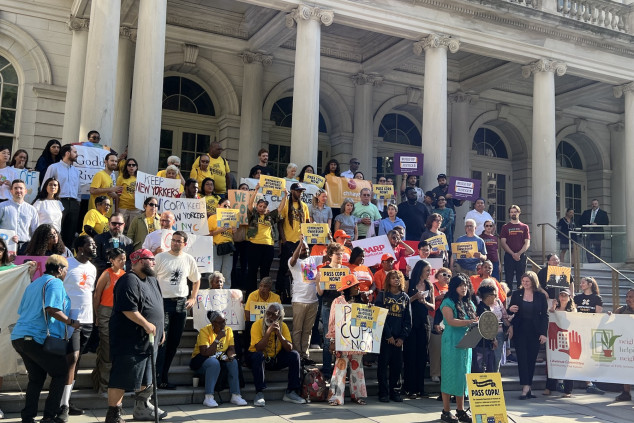
Dozens of tenants, organizers, and housing advocates chanted “pass COPA now!” and shared stories of harrowing housing conditions.
Cassidy Jensen for Brick Underground
Before the start of a hearing of the City Council’s housing committee Wednesday morning, dueling groups on opposing sides of the revived Community Opportunity to Purchase Act hoisted signs and shouted slogans.
Dozens of tenants, organizers, and housing advocates chanted “pass COPA now!” and shared stories of harrowing housing conditions. A few hundred feet away, beyond City Hall Park’s protective barricades, a group of property owners occasionally shouted “unconstitutional!” while holding their own signs.
The Community Opportunity to Purchase Act would give nonprofit groups and community land trusts on New York City’s qualified buyer list the chance to make offers on struggling multi-family buildings when they go up for sale.
COPA’s supporters say it will preserve affordable units in distressed buildings that might otherwise become targets for speculation, leading to the displacement of longtime residents.
Now that the bill has had a committee hearing, it can be scheduled for a committee vote before a vote by the full council. COPA isn’t yet scheduled for a vote, but with 28 co-sponsors, it has the support to pass.
A priority for Mamdani
After former Mayor Eric Adams vetoed a previous iteration of the bill, Mayor Zohran Mamdani included COPA in his housing plan as one of his administration’s priorities.
“The fact is, the private market cannot create enough affordable housing to solve this crisis, especially if we're losing the affordable housing stock we do have faster than we can build,” said Council member Sandy Nurse, who introduced the bill. “This bill is about interrupting a cycle of despair and neglect by design, because many landlords across the city use deterioration as a strategy to get their tenants out,” Nurse said.
Members of the housing committee questioned housing officials about the bill’s details, and tenants and landlords testified about its impact.
“We support this legislation and believe it is aligned with our larger housing preservation goals,” said Dina Levy, commissioner of the Department of Housing Preservation and Development.
How to implement COPA
In response to questions from Nurse, Levy acknowledged that if COPA does pass, HPD will have to go through the rule-making process to determine how the qualified buyers list is set, make sure there is a notification for the buildings subject to COPA, and establish penalties for noncompliance and notify tenants.
HPD makes about 10 to 20 “preservation deals” with groups on the qualified buyer’s list each year, Levy said. She said COPA would apply to an estimated 2,100 buildings—if those buildings were sold today.
Will Spisak, a senior policy strategist at New Economy Project, said COPA would have applied to about 300 buildings sold last year.
Opposition to COPA
Zach Steinberg, executive vice president for external relations and advocacy at the Real Estate Board of New York, praised legislators for amending this version of the bill so that it applies fewer properties, while also limiting HPD’s ability to extend deadlines and shortening the transaction timeline. Still, REBNY, the leading trade association for the NYC real estate industry, wants to see other changes to the bill.
“COPA remains a significant intervention into private property transactions, and additional revisions are needed to provide certainty for owners, lenders, and affordable housing investors,” Steinberg said. “We urge the council to establish reasonable limits on lawsuits and penalties, clarify the timelines governing the right of first refusal process, and place firm limits on administrative extensions.”
Christopher Athineos, a landlord testifying on behalf of Small Property Owners of New York, took an even stronger stance, saying his organization opposes any version of COPA. He said smaller landlords suffer from compounding problems as lower rents cause deferred repairs and code violations, which then lead to higher legal costs and difficulty refinancing.
“We're operating in an environment where policies increase the cost of owning and maintaining regulated housing, which can potentially increase the number of buildings that meet the distress criteria to trigger COPA,” Athineos said. “Don't regulate responsible small property owners into distress and then use that distress as the justification for taking their buildings out of the private market.”
SPONY board member Ilan Rabinovitch expressed the group’s support for a different bill that would allow owners to register their properties with HPD electronically, rather than sending the agency hard copies of documents.
An 'infuriating lack of concern'
Tenants told the committee about a litany of poor conditions in their buildings and shared stories of learning that their homes had been sold to a new buyer without their knowledge.
Stephanie Thomas, a Bronx resident, said her building at 3435 Giles Pl. had no heat in the winter, an inoperable elevator, frequent leaks, and water damage and roaches and mice.
“What’s most infuriating is the lack of concern by the owner and his sons in response to these allegations,” Thomas said.
Changes to housing lottery process
HPD also informed the housing committee about coming changes to the housing lottery process. In the short term, HPD will be making these changes:
- Shortening the lottery period from 60 days to 21 days
- Streamlining the income requirements for renters. For example, if you have proof that you receive a SNAP benefit, that will be sufficient to prove you’re income eligible
- Clarifying the process for first-time occupancy inspections.
The housing committee meeting also weighed changes to the housing lottery application process. Levy proposed cutting in half the waiting period for Housing Connect to approve lottery applicants, reducing the number of days from 210 to 100.
HPD is also working with the NYC Office of Technology and Innovation to make sure the technical system can keep up with these changes. In the longer term, HPD will take a look at the processing of paper applications, appeals and allowing marketing agents to take applications as they receive them, Levy said.
You Might Also Like