





William S. Schneider's 136 Waverly Pl: Medieval and Aztec motifs with early residents on both sides of the law
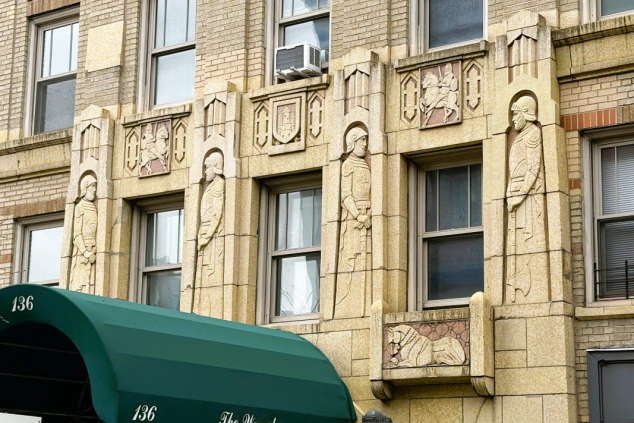
- The Art Deco design features medieval-style decorations in cast stone around the entrance
- A veteran prosecutor and burglar who supplied ammunition to the USSR lived here

An advertisement for The Waverly offered apartments of three or four rooms that included electric refrigerators, a big amenity when many still had iceboxes.
Have you ever passed by an interesting residential building in New York City and wanted to know more about its history? In this series, Brick Underground teams up with Tom Miller, creator of Daytonian in Manhattan, a blog about Manhattan buildings and other historic architecture. Each week, we will run an excerpt from the Daytonian’s archives with a link to the full article.
In 1928, the Citadel Construction Company commissioned architect Walter S. Schneider to design a 16-story apartment building on the southwest corner of Sixth Avenue and Waverly Place, the former site of Greenwich Savings Bank.
Schneider gave the brick-faced structure medieval-style decorations in cast stone around the entrance and Aztec-inspired motifs in terra cotta at the top two floors. He used contrasting brick to create bandcourses and to simulate quoins.
An advertisement for The Waverly offered apartments of three or four rooms that included "dining alcoves [and] electric refrigerators." The electric appliances were a significant amenity at a time when many New Yorkers still had messy iceboxes in their kitchens. Rents started at $900 per year, or about $1,750 a month in 2026 terms.

Residents Margaret and Joseph Sarafite lived here as early as 1940. An attorney, Sarafite had been on the staff of District Attorney Thomas E. Dewey's since 1938. Joseph A. Sarafite was appointed assistant district attorney, then “head of the Rackets Bureau.” The New York Sun reported the latter promotion, noting that since 1938, "of 200 cases on which he worked, convictions were obtained in 98 per cent of them."
Among the Sarafite's neighbors in the building was Gerard Mosiello, described by The New York Times on June 29th 1943 as "a convicted burglar." His brother, Anthony, who lived on Sullivan Street, was described by the FBI as "a bookmaker." The brothers and two other men formed a corporation to supply ammunition to the Soviet Government.
All four men were arrested in 1943 not for supplying munitions to a foreign entity, but for fraud. The New York Times said they devised "a scheme alleged to have been carried out in the shipment to Russia of 3,072,000 .45 caliber cartridges, of which 38 per cent were found to be dangerously defective."
A renovation to the building completed in 1967 resulted in eight stores at street level, five apartments per floor in the upper section, and one in the penthouse level.
For more on this building, check out the full article.


