




Landlords suing to reverse Rent Guidelines Board’s rent freeze face an ‘uphill battle’
- Attorneys tell Brick ‘arbitrary and capricious’ legal standard is a high one
- Previous lawsuits challenging the board’s increases or freezes have failed
If the plaintiffs win, the decision would be sent back to the Rent Guidelines Board to reconsider.
iStock
A group of landlords suing to reverse the Rent Guidelines Board’s recent rent freeze must meet a high legal standard, tenant attorneys said, making them unlikely to win in court.
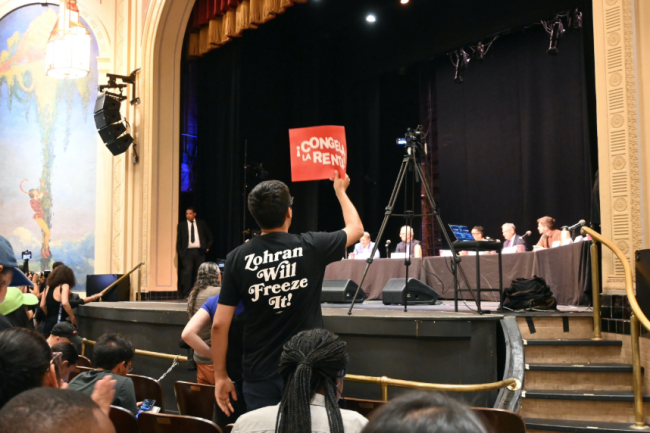
In June, eight members of the board (one member resigned the morning of the vote) approved rent freezes on both one- and two-year leases for rent stabilized tenants in an unprecedented decision. Unhappy with the vote, a group of six landlords last month sued the board in an attempt to reverse the freeze, which goes into effect Oct. 1st.
The plaintiffs, who own buildings in Queens, Staten Island, Brooklyn, and the Bronx, argued that the board failed to act independently of Mayor Zohran Mamdani—who ran for office on a promise of freezing the rent for stabilized tenants and appointed five new members. The plaintiffs argued that the board ignored housing data to achieve the mayor’s goals.
If they win, the decision would be sent back to the board to reconsider.
Randy Mastro, a former deputy mayor under Mayor Eric Adams, is part of the legal team representing the landlords. A spokesperson for Mastro did not respond to a question from Brick about the difficulty of winning what’s known as an Article 78 case challenging a government agency’s decision.
“This was a sham process with a predetermined outcome that Mayor Mamdani dictated by fiat,” Mastro said in a statement. “To deliver on the mayor's campaign promise of a rent freeze, the Board then had to disregard its statutory mandate and manipulate its own data, intentionally underestimating operating costs and intentionally overstating income of landlords.”
High legal standard
The legal standard the plaintiffs must meet is a high one, according to Jennifer Rozen, managing attorney at the Rozen Law Group. “I think the landlords face an uphill battle regarding the lawsuit they filed,” Rozen said in an email to Brick.
The court will review the board’s decisions under a standard that gives deference to administrative agencies, Rozen said, assessing if the move was “arbitrary and capricious,” an error of law or lacking support in the factors the RGB has to consider when deciding rent increases.
Previous lawsuits challenging the board’s increases or freezes have failed. Rozen said the landlords’ best chance of success would be to convince the court that the process was “legally defective,” and that the board failed to genuinely consider economic factors.
“Unless the plaintiffs uncover compelling evidence that the process was effectively predetermined or that the RGB disregarded mandatory statutory factors, I think the city is more likely than not to prevail,” Rozen said.
A spokesperson for the city’s law department did not respond to a request for comment on the case.
Tenant attorney Altagracia Pierre-Outerbridge, founder of Outerbridge Law and a Brick sponsor, has represented clients in similar cases. She said that the court is not allowed to “reweigh,” or evaluate the evidence itself; it can only determine if the board had no rational reason at all for its decision.
“I can’t tell if it’s going to succeed or not,” Pierre-Outerbridge said, “I do know if landlords don’t push back, then that’s that.” Regardless of its outcome, she views the case as a message from landlords to future boards to be careful in their process or risk future lawsuits.
Mayoral interference?
One piece of evidence cited in the landlords’ pleadings is a resignation letter from Christine Smyth, the board’s landlord representative who quit the morning of the vote.
In a three-page letter, Smyth, a real estate attorney, claimed the board members were determined to vote for a rent freeze regardless of the data. “The Rent Guidelines Board has stopped being a fact-finding body. It has become a body that starts with an answer and vibe codes its way backward to justify it,” she wrote in her letter.
However, the sole board member who voted against the rent freeze, public representative Arpit Gupta, said in a conversation with Vital City that he felt the administration and its staff had acted independently.
“One thing I can say is that, unlike in some previous years, I observed no interference by the administration in individual members’ decisions,” Gupta said.
A political process
NYC’s mayor has the authority to appoint members of the board, but in their suit the landlords argued that the Mamdani administration went further than that, in part by using city resources to encourage tenants to speak at hearings.
“The process is politicized by nature because the mayor has announced what he wanted, and the mayor appoints the appointees,” Outerbridge said. “So you can’t really get away from the politics.”
After the case was filed, tenant groups argued that previous mayors had similarly appointed board members to pursue their housing agendas.
“Under the Adams administration, the RGB hiked the rent again and again, ignoring tenants’ economic reality and helping landlord profits soar,” said Sumathy Kumar, executive director of NYS Tenant Bloc, in a statement.
Darius Khalil Gordon, executive director of the tenant group Met Council on Housing, also said the Adams administration had tried to stack the board against tenants. Met Council will intervene in the case, Gordon said in an interview.
“I think this is a response to a mayor and an administration that has been listening to tenants and folks who are really working class,” Gordon said of the landlords’ lawsuit.
Landlords: ‘The courts are our only remedy’
The New York Apartment Association, which represents rent-stabilized landlords and under a previous name unsuccessfully sued the RGB for a rent freeze under Mayor Bill de Blasio, is not participating in this lawsuit. A spokesperson for NYAA did not respond to a request for comment.
Ann Korchak, board president of Small Property Owners of New York, said this rent freeze differs from ones the board approved under de Blasio, which occurred while inflation was low or during the extraordinary circumstances of the Covid pandemic.
“The courts are our only remedy at this point,” Korchak said. She believes the plaintiffs, at least three of which are SPONY members, will win their case.
“And if we don’t, what chance is there for anyone who owns a piece of property to be treated fairly by government?” Korchak said.
You Might Also Like