




The 1889 Louis Isaacs House at 349 West 122nd St: Part of a new neighborhood and home to a tabloid scandal
- Within three years, the Teets brothers transformed a block of vacant lots on West 122nd Street
- One early resident was part of double teenage wedding prank that scandalized New York society

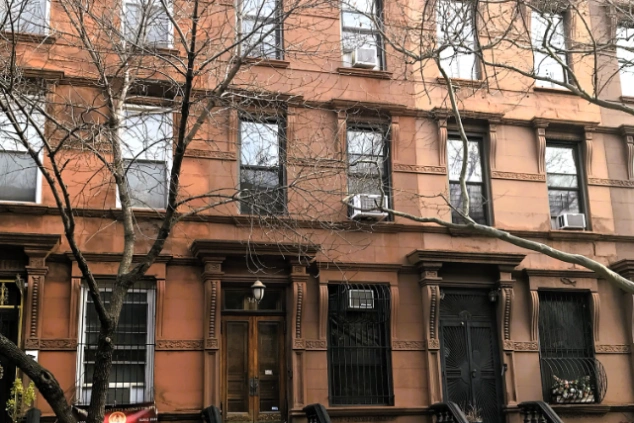
The house, completed in 1889, was just 15 feet wide and identical to its neighbors.
Have you ever passed by an interesting residential building in New York City and wanted to know more about its history? In this series, Brick Underground teams up with Tom Miller, creator of Daytonian in Manhattan, a blog about Manhattan buildings and other historic architecture. Each week, we will run an excerpt from the Daytonian’s archives with a link to the full article.
Within a three-year span, brothers Joseph W. and Abram Alonzo Teets transformed a block of West 122nd Street between Morningside Avenue and Manhattan Avenue from vacant lots into a neighborhood. In 1888, they hired architect J. A. Webster to design 11 brownstones on the north side of the block. The following year, Webster designed 10 houses on the south side for the brothers.
Part of the initial project was 349 West 122nd St. The house, completed in 1889, was just 15 feet wide and identical to its neighbors. The tall stoop was guarded by beefy iron newels and railings. Each floor was belted with carved foliate bands, and the windows wore prominent molded cornices supported by fluted brackets.
Subsequent occupants included the family of James F. Douglass, a woolens importer at 244 Fifth Ave. He and his wife had a son and daughter—and the daughter, Lorene, made the Douglass name fodder for newspapers nationwide.
In the summer of 1907, Lorene, who was then 15 years old, snuck away to get married to another underage teen, along with another pair of friends. All four lied about their ages to a Methodist minister Rev. M. Wilson in Oyster Bay, N.Y. Despite their youthful appearance and clothing, and the fact that the four giggled and made light of the ceremony, Rev. Wilson married the two couples.
When the marriages came to light, according to The Anaconda Standard, a Montana newspaper, they "caused wrath and consternation in the homes of four well-known New York families." The New York Times discovered that the Douglasses "consulted their lawyers early in the summer, and were told that the marriages were not binding owing to the ages of the four."
At some point, the property became a rooming house. Surprisingly, given that Harlem had become the epicenter of Manhattan's Black community, the tenants seem to have been mostly German. Living here in 1934, for instance, were Peter Franz and Meyer Goldschmidt.
The property sold several times in quick succession during the Depression; in December 1936 and in November 1937 for $6,500 (about $142,000 today).
Restored in recent years to a single-family home, a surprising amount of original interior detailing survives throughout the house, as seen in a 2020 listing.
For more on this building and the shenanigans of its inhabitants, check out the full article.
You Might Also Like