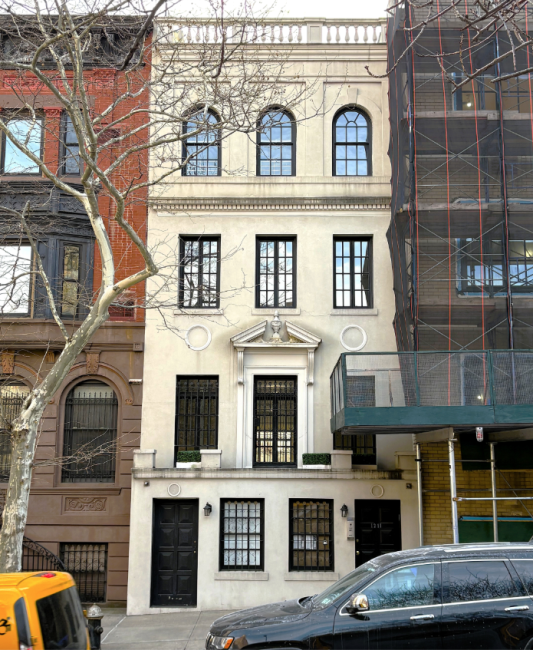





The 1861 Conant House at 25 Stuyvesant St: A narrow Anglo-Italianate home on a triangular plot
- Houses on the irregular property ranged from 16-to-32 feet wide and 16-to-48 feet deep
- The Conant children’s governess became an influential anthropologist studying Native Americans


Journalist and author Nina Munk purchased the house in 2011 and sold it in 2016 for $6.5 million.
Have you ever passed by an interesting residential building in New York City and wanted to know more about its history? In this series, Brick Underground teams up with Tom Miller, creator of Daytonian in Manhattan, a blog about Manhattan buildings and other historic architecture. Each week, we will run an excerpt from the Daytonian’s archives with a link to the full article.
The regimented Manhattan street grid created by the 1811 Commissioners Plan was interrupted by the diagonally running Stuyvesant Street, originally a lane created by the Stuyvesant family to separate their two farms, Bouwerij #1 and #2. In 1854, Matthias Banta purchased the triangular plot between Stuyvesant Street and East 10th Street for development.
Banta's five-story Anglo-Italianate houses were completed in 1861. They varied from 16 to 32 feet wide and because of the triangular plot, their depths ranged from 16 to 48 feet. Among the narrowest was 25 Stuyvesant St. Like its neighbors, its rusticated brownstone basement and first floors sat below four stories of red brick trimmed in stone. A tall, stone bandcourse connected the fully arched windows of the second floor.
Matthias Banta retained ownership and leased the property to Margaret Madden, who operated it for a short time as a boarding house.
Following the Civil War, the house was leased by the family of Claudius Buchanan Conant, a wealthy hardware merchant. Alice Cunningham Fletcher was the children’s governess. She continued to live there after her service ended, becoming involved in women’s causes and later turning to anthropology and ethnology, making extensive trips to the West to study Native American culture.
Fletcher became one of the most influential anthropologists studying Native Americans and helped write the Daws Act of 1887, which eliminated reservations and distributed communal land to individual households.

By the turn of the century, the neighborhood had declined. A 1901 police report listed 25 Stuyvesant St. among "suspicious houses of prostitution.”
For more on 25 Stuyvesant St. and its colorful history, check out the full article.
You Might Also Like