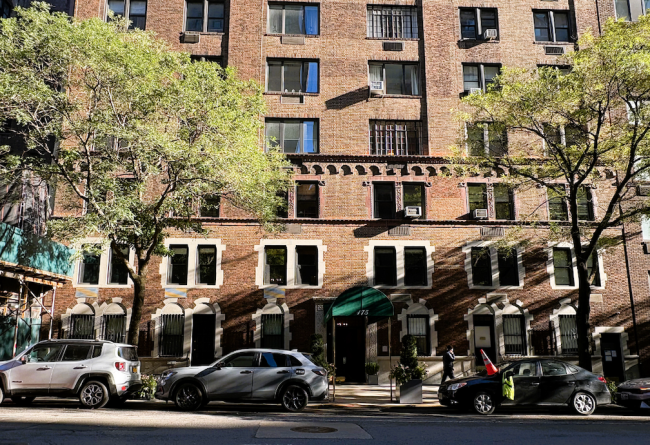





Kafka & Mott's 268 West 84th St: An 1896 apartment building for the upper middle class
- Early tenants could choose apartments of seven or eight rooms with a bath

In 1945, the once-sprawling apartments were chopped up into a single-room-occupancy hotel. But in 1972, the building was converted back to apartments.
Have you ever passed by an interesting residential building in New York City and wanted to know more about its history? In this series, Brick Underground teams up with Tom Miller, creator of Daytonian in Manhattan, a blog about Manhattan buildings and other historic architecture. Each week, we run an excerpt from the Daytonian’s archives with a link to the full article.
Hugo Kafka and Charles T. Mott opened their architectural office around 1893. Among their earliest commissions was a six-story apartment building at 268 West 84th St. for attorney Frederick Prentiss Foster. Construction of the building was completed in 1896, and Foster was apparently well pleased. He immediately hired Kafka & Mott to design his own home directly next door at 270 West 84th Street.
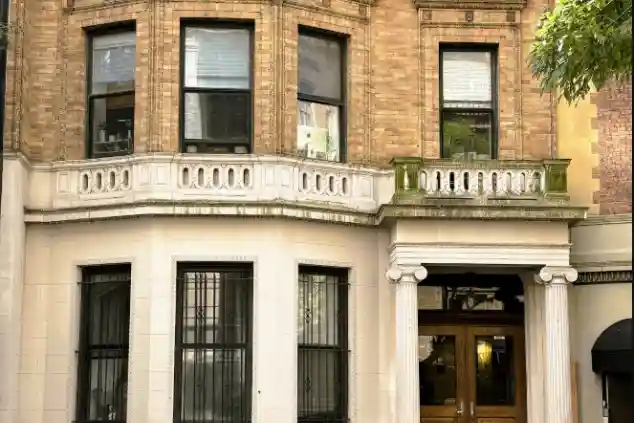
The architects' Renaissance Revival design featured a three-sided bay that projected forward. A Scamozzi columned portico sat above a short stoop. The upper floors were faced in ironspot brick and trimmed with terra cotta, the color which perfectly matched the brick.
Potential residents could choose apartments of either seven or eight rooms with a bath. They filled with upper-middle class families. Among the first were Dr. John Lewis; Lockwood Jr., a psychologist; and Henry B. Stillman and his wife. Stillman was included on the special list of the 1898 The Art Directory as a buyer of art objects. His wife was sat on the Board of Managers of the New York Kindergarten Association. The affluent residents maintained a small domestic staff.
In 1914, Count Max Lyar Louden and his wife, the former Lalia Florence Allendorf, rented an apartment here. What the landlady, Blanche Haskins, did not know was that Louden was also known as Count Rocher M. zu Lynar, Albert Marcel Count de Passy, Jean Marcel Peyrgne, Max Schiemangk, Max de Chimang, and Max Louden, according to The New York Times a year later. He was arrested in October 1915, "accused of three marriages."
Louden's illegal marital practices triggered a deeper investigation. On October 18, 1915, The New York Times reported that through the Marriage License Bureau, "there has been traced a connection which, it is believed, established the identify of the alleged Count." The article said he was "suspected of being a German spy."
The building continued to be home to financially comfortable families in the post-World War I years. An advertisement in the New York Herald on September 5th, 1922, offered eight-room apartments at rents from $2,280 to $2,700 per year.
As midcentury approached, the neighborhood suffered a decline. In 1945, the once-sprawling apartments were chopped up. Now a single-room-occupancy hotel, there were seven furnished rooms on each floor.
Change to the building came again in 1972, when a conversion to apartments was completed. There are now three apartments per floor in the building.
For more on the property and the lives of the colorful residents that lived here, check out the full article.
You Might Also Like