




Julius Boekell's 1877 238 East 6th St: A striking neo-Grec design
- The building sat within Little Germany but the surnames of early residents reflected a mix of ethnicities

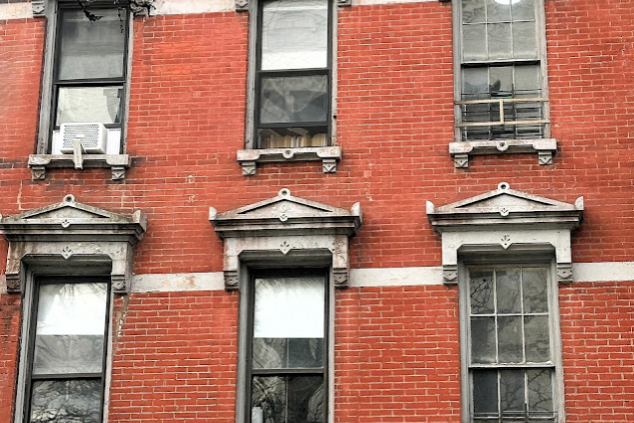
The Greek-inspired treatment of the second-floor lintels was highly unusual.
Anthony Bellov for Daytonian in Manhattan
Have you ever passed by an interesting residential building in New York City and wanted to know more about its history? In this series, Brick Underground teams up with Tom Miller, creator of Daytonian in Manhattan, a blog about Manhattan buildings and other historic architecture. Each week, we run an excerpt from the Daytonian’s archives with a link to the full article.
Although Frederick Pflueger was a partner with his brother Christopher in the real estate development firm C. & F. Pflueger, he and his wife, Annie, often operated on their own. That was the case in September 1876, when Frederick purchased a one-story building at the southwest corner of Second Avenue and East 6th Street.
Pflueger hired architect Julius Boekell to design two buildings on the site. The slightly smaller structure at 238 East 6th St. shared all the decorative elements of the corner building, other than its quoins. Boekell designed the buildings in the popular neo-Grec style, and his choices were striking.

Typical of the neo-Grec style, the windows at each floor were connected by stone bands. Their earred lintels were treated differently at each level. Those of the second floor were influenced by ancient Greece. The third-floor lintels were capped by peaked molded cornices with incised decorations. The third and fourth floor lintels had molded cornices and incised designs.
Two stores flanked the entrance. Although the building sat within Kleindeutschland, or Little Germany, the surnames of the early residents reflected a mix of Irish, German, French and other ethnicities. Among the first residents were butcher Alexander Zadig and his wife, Minnie.
Not everything was going well within the Zadig apartment. On August 8th, 1879, the New-York Tribune reported that Alexander had committed his wife "to a lunatic asylum yesterday." Whether Minnie actually had mental problems will never be known, but a common method of discarding a problematic relative or getting control of their money was to have them committed.
In the pre-World War I years, a Russian and Slavish print shop, as listed in The American Printer, occupied one of the storefronts. The Russian language newspaper Russky Golos (The Russian Voice) was published here and one of its early editorials warned the world about a Bolshevik plot in Russia.
The ground floor of Julius Boekell's 1877 structure has been totally altered but the upper floors, with his compelling window treatments, survive intact.
For more on this building and its inhabitants, check out the full article.
You Might Also Like