





Jobst Hoffman's 1880 29 East 7th St: A double-flat building that is part of a whimsical trio
- Hoffman was hired by another developer to replicate his design at 25 and 27 East 7th St.
- The architect blended Queen Anne and neo-Grec styles with a fanciful decorations

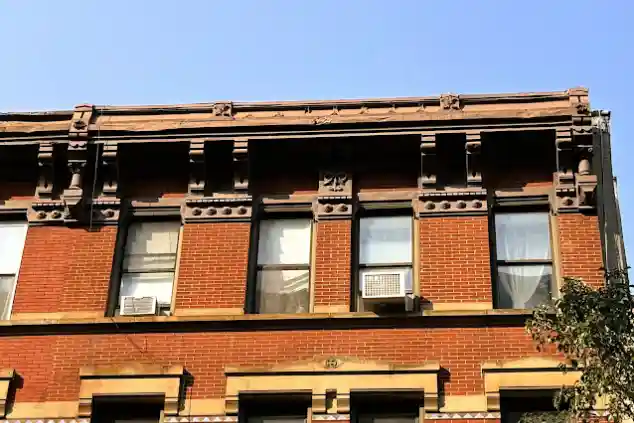
The brick piers of the top floor wore cast metal capitals decorated with roses. They upheld the corbels of the elaborate pressed metal cornice.
Have you ever passed by an interesting residential building in New York City and wanted to know more about its history? In this series, Brick Underground teams up with Tom Miller, creator of Daytonian in Manhattan, a blog about Manhattan buildings and other historic architecture. Each week, we run an excerpt from the Daytonian’s archives with a link to the full article.
German-born architect Jobst Hoffmann filed plans for a "five-story brick apartment house" at 29 East 7th St. in February 1880 for developer Isaak Horchster. Hoffmann's plans projected the cost of construction at $11,000, or about $357,000 in 2026 terms. Soon after, Hoffman was hired by Z. H. Miller to design two apartment buildings at 25 and 27 East 7th St. that would exactly match 29 East 7th Street.
Hoffman's design was a blend of Queen Anne and neo-Grec styles. He also included a whimsical cast iron fencing and stoop railings with stylized sunflowers.
The paired ground-floor openings shared a lintel decorated with a small rosette. The centered entrance was crowned with an earred cornice inspired by ancient Greece. The four upper stories were clad in red brick and trimmed in sandstone. Hooded lintels decorated the second and fourth floor openings and between the third and fourth, Hoffmann added colorful encaustic, quilt-like tiles.
No. 29 East 7th Street was known as a double flat, which meant there were two apartments per floor. Among the initial tenants was Auguste Schelcher. He was on his way with friends to the ball of the Société Culinaire Philanthropique on the evening of April 30th, 1883, when his night of gaiety turned to horror. The New York Times reported that as they passed 404 Sixth Ave., Désiré L. Houvet, a French chef and another member of the Société Culinaire Philanthropique, exited the building and collapsed.
The "elegantly dressed" Houvet had just been stabbed in the back by Elizabeth Quinquinet. The New York Times would later explain, "Houvet, who was single, had led Mrs. Quinquinet astray and they had quarreled." The 33-year-old Houvet died on the scene.
The Hessler family occupied an apartment here in 1896 when their 15-year-old son, Charles, became a hero of sorts. On the afternoon of July 7th, Charles was on the Bowery near Catharine Street. He saw 68-year-old John M. Sweitzer, who was inebriated and staggering along the sidewalk. Suddenly three men rushed up and robbed him of $40. The New-York Tribune explained that Sweitzer, "was unable, owing to his condition, to furnish any description of the robbers."
Young Hessler, however, was able to describe them and pointed out one of the accomplices to police. On the weight of teen's affidavit, the accomplice was committed to the Tombs Prison for further investigation.
By 1924, the basement level of 29 East 7th St. had been converted to two commercial spaces. Operating from one of them that year was George Withers Music Co.
There are still just two apartments per floor in 29 East 7th St. Because Z. H. Miller wisely decided to have Hoffmann recreate his design at Nos. 25 and 27, the trio has an enhanced presence.
For more on the property and the interesting people that lived here, check out the full article.


