




The 1899 Henry Schwarzwalder House at 24 West 76th St: Decorated with Beaux Arts details and raided by Hoover’s FBI agents
- The 25-foot-wide limestone Renaissance Revival townhouse cost $40,000 to construct
- In 1941, FBI agents stormed the mansion and arrested a couple living here for espionage

Have you ever passed by an interesting residential building in New York City and wanted to know more about its history? In this series, Brick Underground teams up with Tom Miller, creator of Daytonian in Manhattan, a blog about Manhattan buildings and other historic architecture. Each week, we run an excerpt from the Daytonian’s archives with a link to the full article.
Real estate developer James Carlew erected five sumptuous, 25-foot-wide townhouses on West 76th Street between Central Park West and Columbus Avenue in 1898-1899. Designed by Cleverdon & Putzel, each residence cost Carlew $40,000 to construct.
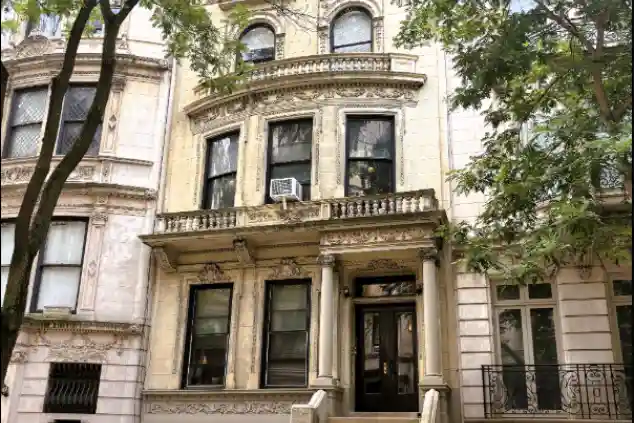
Faced in limestone, 24 West 76th St. is, like the others, four stories tall above an English basement. Cleverdon & Putzel splashed the Renaissance Revival design with Beaux Arts details, like frothy cartouches above the parlor floors. A dog-legged box stoop rises to a columned portico. The bowed second-floor oriel is fronted by a stone balcony and crowned by a tiara of balustrades. The fully arched windows of the third floor sit within square-headed architraves, and the piers that flanked the fourth-floor openings are intricately carved with Renaissance inspired decorations.
James Carlew sold the house to Henry Schwarzwalder and his wife, the former Louisa Finck. Louisa was Henry's second wife. He married Alice Finck (Louisa's sister) in 1877. She died shortly after the birth of their daughter, Amelia, and Henry then married Louisa. They had a daughter, also named Louisa.
Henry took over the operation of J. Schwarzwalder & Sons following his father's death, the largest maker of beer kegs in the United States.
The home changed hands several time until the mid-1930s. In the early years of the Second World War, 24 West 76th St. operated as rented rooms. Evelyn Clayton Lewis rather scandalously shared a room here with Frederick "Fritz" Joubert Duquesne in 1941. Evelyn, who was 24 years old, was an "artist, sculptress and playwright," according to The New York Sun. Frederick, who was 64, listed his occupation as "writer and lecturer." Born in Cape Colony, South Africa, Duquesne was a naturalized citizen.
Thinking of buying or renting in this building? Get a Brick Report for 24 West 76th St and find any known issues like pests, construction projects, or DOB violations.
But according to J. Edgar Hoover, he had "served as a spy in the Boer War and in addition was active in behalf of the German interests" in World War I.
As it turned out, Evelyn and Frederick's living arrangements had nothing to do with romance. On June 28th, 1941, FBI agents stormed into their rooms here and arrested the pair for espionage. Two days later, The New York Times reported that their arrest—along with 25 other men and two women—had broken a German spy ring. The article said, "The most important of the prisoners was described by Mr. Hoover as Frederick Joubert Duquesne."
Frederick Duquesne would serve 12 years in prison and Evelyn was sentenced to 18 months in Atlanta "for acting as a foreign agent."
Other residents of 24 West 76th St. were, expectedly, less notorious.
British-born writer Nik Cohn lived here in the early 1980s. A magazine article he wrote in 1976 inspired the movie Saturday Night Fever. He earned less positive press on May 19th, 1983, when a raid on his apartment resulted in his arrest along with 18 others for operating a "drug ring that operated out of Mr. Cohn's Manhattan town house," according to The New York Times.
Although never officially converted to apartments, there are 10 rental units in the building today. From the sidewalk, the former mansion looks much as it did in 1899 when the Schwarzwalder family moved in.
For more on the property and the interesting people that lived here, check out the full article.
You Might Also Like