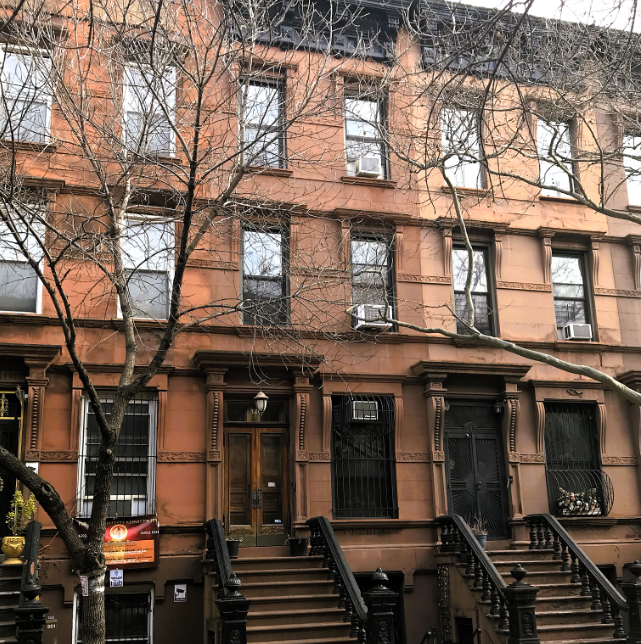





The William Sackett Jr. House at 123 East 10th St: An elegant home where Peter Stuyvesant once farmed
- Development took off on East 10th Street between Second and Third in the early 1850s
- The block was once part of Director General Peter Stuyvesant's farm or 'bouwerij'

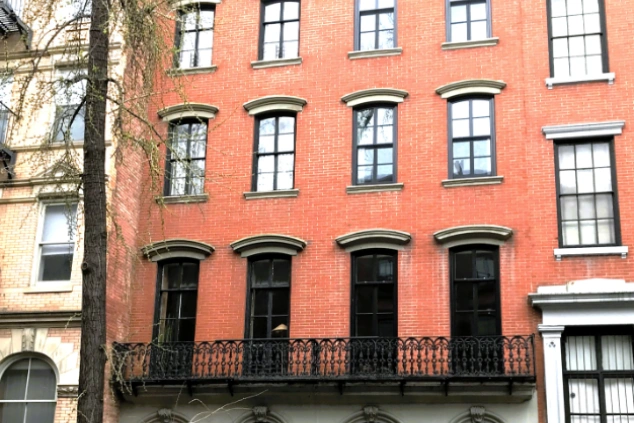
The red brick-faced upper floors featured elliptically arched openings with molded stone lintels.
Have you ever passed by an interesting residential building in New York City and wanted to know more about its history? In this series, Brick Underground teams up with Tom Miller, creator of Daytonian in Manhattan, a blog about Manhattan buildings and other historic architecture. Each week, we run an excerpt from the Daytonian’s archives with a link to the full article.
Once part of Director General Peter Stuyvesant's farm, or bouwerij, the block of East 10th Street between Second and Third avenues saw an explosion of development in the early 1850s.
Robert and Franny Carnley moved into a newly built house at 191 10th St. and in 1854, Robert erected two matching homes next door to each other at 193 and 195 (they would be renumbered 123 and 125 East 10th St. in 1865).
Four stories tall and two bays wide above a low basement, the rusticated first floors held fully arched openings. Full-width cast iron balconies fronted the second-floor windows. The red brick-faced upper floors featured elliptically arched openings with molded stone lintels.
Carnley initially rented out 193 10th Street. His first tenants were the family of James P. Harper, a grocer, who remained through 1857. They were replaced by the Kendall family. Merchant Joseph A. Kendall operated an enterprise at 30 Barclay St. and Rufus W. Kendall ran a dry goods business on Vesey Street.
On January 20th, 1864, the Carnleys' daughter, Frances (known as Fanny), married William H. Sackett, Jr. The couple initially moved into the Carnley house, but by 1866 they owned and occupied 123 East 10th St. next door. Sackett operated a furniture business at 397 Eighth Ave.
The Sacketts left 123 East 10th St. in 1871 but retained ownership. The Donoho family occupied it in 1872. Sisters Mary and Margaret, who were 25 and 28 years old respectively, worked in Archer & Anderson's bookbindery at 81-85 Centre St.
On the afternoon of Christmas Eve 1872, a fire broke out in the Centre Street building. Four days after the inferno, the New York Herald reported that the Donoho sisters were among the seven bodies still not recovered from the ruins.
In later years, the house saw a rapid succession of renters as it changed hands.
The venerable house was never converted to apartments and remains a single-family home today. Its exterior appearance is essentially unchanged since 1854.
For more on this building and its inhabitants, check out the full article.
You Might Also Like