




IKEA vs. Home Depot: Which should you choose for a NYC kitchen renovation?
- Home Depot kitchens run about $30,000 to $35,000, while IKEA kitchens range from $10,000 to $15,000
- Prices at Home Depot depend on whether you go with ready-to-assemble or pre-assembled stock cabinetry

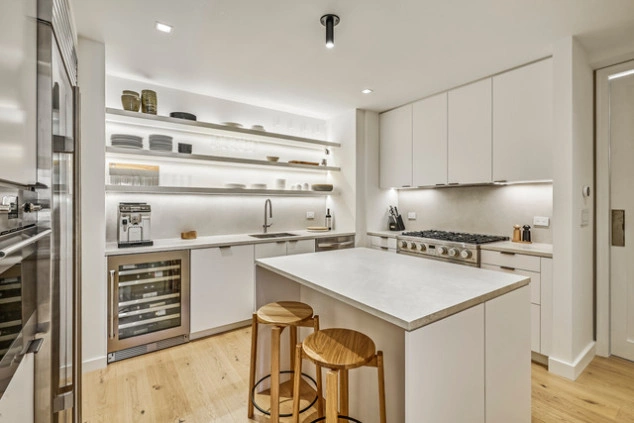
This Park Avenue kitchen update by Prime Renovations combined IKEA cabinets with custom shelves and countertops.
Prime Renovations
I'm thinking of renovating my NYC kitchen and I am hoping to stay within a budget by using IKEA or Home Depot for cabinets. Any thoughts on which retailer offers the best value?
If you're trying to keep to a budget with your New York City kitchen renovation, you probably already know that using Home Depot or IKEA for new cabinets will save you money. What you may not know is that a lot of designers go this route with high-end projects—and then (usually) add their own custom touches.
Jeff Streich, founder of Prime Renovations, has used IKEA cabinets in projects ranging from $500,000 to $5 million, including one he just completed on Park Avenue. "It was not inexpensive, but the client did not have an unlimited budget, so it was decided that an Ikea kitchen was a great place to save money to spend on other wants," he said.
Here's how he and other experts rank IKEA and Home Depot on price, durability, style, service, and installation.
[Editor’s note: A previous version of this article was published in March 2023. We are presenting it here with updated information for February 2026.]
How do prices compare for IKEA vs. Home Depot?
According to Dan DiClerico, home improvement and outdoor director for the Good Housekeeping Institute, most Home Depot kitchen cabinet projects (materials and installation) typically range from about $5,000 to $20,000 or more, depending on the size, style, and level of customization of your cabinetry.
Meanwhile, a full IKEA kitchen—including cabinet materials and professional installation—will generally cost about $3,000 to $6,500 for an average-sized layout.
At Home Depot, ready-to-assemble (RTA) or stock cabinet options tend to run roughly $100–$300 per linear foot installed, with higher-end or semi-custom configurations costing more. IKEA cabinets themselves now often cost around $200 to $1,200 per cabinet (materials alone), with most falling in the mid-range.
Note: These figures are for cabinets and installation only and do not include flooring, countertops, appliances, or other renovation costs.

Which one has more selection?
Home Depot definitely has more options. "That’s because IKEA primarily sells its own branded products, while Home Depot carries a bunch of different brands," DiClerico said.
Having fewer choices can certainly ease the decision-making process, especially since the SEKTION line is still the core cabinet system—frames, drawers, internal organizers, brackets and rails that form the structure of your kitchen. SEKTION fronts come in Shaker, modern flat-panel, and more traditional beveled options and seven colorways.
That said, IKEA has greatly expanded its offerings to include more than 60 compatible fronts in various finishes and sizes across 15 families—from the SINORP oak veneer to the high-gloss white RINGHULT series. These are sold as separate elements that attach to the SEKTION frames, and you can mix and match styles as long as they fit the cabinet dimensions.
IKEA also introduced two new base kitchens: the KNOXHULT modular system and the flexible EHNET system, both available with white, oak, and dark gray fronts.
With Home Depot, you have to evaluate each brand. That can be a plus or minus depending on your patience and perseverance. Having lots of options isn't always the end-all, be-all either. Yaiza Armbruster, founder of Atelier Armbruster, once inquired about a Martha Stewart kitchen at Home Depot and decided against it because the components wouldn't arrive in time for a small project's schedule.
On the other hand, she finds IKEA to be much more customizable since companies like Semihandmade and Reform make IKEA-compatible fronts in a range of finishes and styles—and you can paint them any color you want, Armbruster said. Semihandmade, for one, offers over 50 options, many of which ship within five to six weeks.
Lenzlinger has used fronts from Dunsmuir Cabinets (available in wood, prefinished wood, and ultra-matte laminates) and The Cabinet Face (which makes flat-panel or Shaker-style melamine as well as glass fronts). She did report issues with warped doors in one of two recent jobs using Cabinet Face doors, though the company sent replacements without a fuss.
Even when using IKEA fronts, you can shop elsewhere for exterior hardware. Armbruster added brass pulls from Schoolhouse Electric. (Rejuvenation is another favorite source) and repurposed a brushed-brass corner guard that would typically be used on a wall to hide under-cabinet strip LED lighting.

All experts here opted to source the countertop and backsplash elsewhere, as IKEA offers only two options—wood veneer and laminate. The same goes for Home Depot cabinets. Here, Armbruster used a high-tech matte black countertop from FENIX (it is scratch- and fingerprint-resistant); the backsplash was designed with tiles from Town and Country Surfaces.
Streich emphasized that "not everyone can do an IKEA kitchen" like the one shown at top (and below) because much of it was customized by his team.

One final style point: Home Depot offers a "cabinet makeover" service that refinishes the existing fronts, and some are easy enough to repaint on your own. IKEA cabinets cannot be easily repainted without major stripping, preferably by taking them to a millworker. Of course, you can always buy new fronts, but that might not be something you want to do.
What do the experts say about durability?
Even though the quality of stock cabinets from IKEA and Home Depot isn't on par with custom work, DiClerico said they’re surprisingly sturdy and durable.
All IKEA cabinets are made of medium-density fiberboard (MDF), as are many Home Depot RTA products, while others are made of plywood.
Only a couple of the experts interviewed had enough (or any) experience with Home Depot products to speak to how well they hold up over time, though you can read reviews on the website to get a sense of what customers have to say.
On the other hand, all experts agreed that IKEA kitchens are built to last, at least when it comes to the "box" or core components and the hinges and inner hardware. Having installed some 60 to 80 IKEA kitchens over the past seven years, Streich said his clients have never had an issue, unlike with other types of cabinets. That's saying something.
IKEA fronts—which Armbruster described as "a little flimsy"—are the exception to the rule.
For starters, they are five-eighths of an inch thick compared to the standard three-quarters of an inch you'll find with most Home Depot brands (and the industry standard). They are also prone to dings and scratches.
That's why most experts often go with other options for IKEA fronts. "Just be sure to account for that extra thickness in your countertop," advised Meret Lenzlinger, founder of Lenzlinger Architecture. (More on fronts below.)
For her, the biggest drawback is that, since 2014 (when SEKTION replaced the AKURIUM system), IKEA's upper cabinets have a 15-inch depth rather than the standard 12-inch depth. Home Depot's cabinets, on the other hand, range from 12 to 18 inches.
And buyer beware: IKEA cabinets and fronts have different warranties: five years for KNOXHULT, 10 years for EHNET, and 25 years for SEKTION. Home Depot offers a limited lifetime warranty—be sure to read the fine print.

Which retailer gets better delivery ratings?
Streich, for one, said, "you can't beat the quick delivery" for IKEA.
Sure enough, IKEA's delivery has traditionally been quicker—less than seven weeks, compared with as long as 12 weeks for Home Depot.
Lenzlinger said she never willingly uses Home Depot kitchens, not because of the products, but because of the delivery process. "They changed my designs so that once installed, the cabinets cannot open without banging into the range," she said.

How does IKEA's installation compare to Home Depot's?
Home Depot cabinets are relatively easy to install, especially the pre-assembled ones—but even their RTA models have far fewer pieces and more standardized instructions.
Not so with IKEA, as anyone who has tried to assemble one of their simple desks or bunk beds knows, much more so an entire kitchen system.
"IKEA's biggest issue is that there are so many bits and pieces and you may not know what to look for in terms of what might be left out," said Guy Kohn, founder of Kohn Architecture. A typical scenario means your contractor has to deal with 100-plus flat-pack boxes and might not even know what has been ordered. "But when I used an IKEA-recommended installer, the process went fairly smoothly," he said.
Streich, too, hired someone who was very familiar with them (and has now installed more than 60 systems).
Nowadays, companies also help New Yorkers with their IKEA installations, and some even handle pickup and delivery.
What are other good kitchen cabinet brands?
If you don't find what you want at IKEA or Home Depot, the experts suggest turning to other companies that offer high-quality, reasonably priced cabinets in both standard and custom sizes.
Kohn particularly likes Pennsylvania-based Wolf Home Products (especially the Wolf Classic line) that you can see in their Brooklyn showroom. "You wouldn’t know the difference between those and a very fancy brand, even if you open them up," he said.
Armbruster worked with NYC-based Intelligent Kitchen on a couple of projects. "It’s slightly more upscale and more customizable, and their product is really good," she said.
For the most part, Jorge Fontan, founder of Fontan Architecture, finds that semi-custom cabinets feel cheap given their steep price tags. "A lot of contractors will say they are just more expensive versions of IKEA," he said. So he would suggest custom (or truly high-end companies like Henry Built) over expensive semi-custom.
If RTA is more in line with your budget, Lenzlinger used Conestoga systems on two projects with just one quibble: These cabinets (and Home Depot brands) use the American cabinetry system, which eats up a little space thanks to a small frame inside the door. This is unlike IKEA products, where the hinge attaches directly to the door. On the plus side, you have greater flexibility in designing the layout and can get what you like delivered with a painted factory finish in either their own color range or your own shade, she added.
Lenzlinger also happily discovered Cabinets.com, "the first budget company to sell a frameless (‘full access’) cabinet, which thrills me. And it’s very inexpensive." She used these cabinets in a kitchen renovation, putting them in the L-shaped main part, and then had Conestoga make an island "because we wanted a custom color!"
The final verdict on IKEA vs. Home Depot
There are plenty of good reasons to get kitchen cabinets from IKEA or Home Depot, despite their service hiccups.
Whichever you end up using, be sure to visit the stores to see, touch, and test the cabinets in person—preferably avoiding weekends and other high-traffic times (usually right after work).
—Earlier versions of this article contained reporting and writing by Sarah Wormser.
You Might Also Like