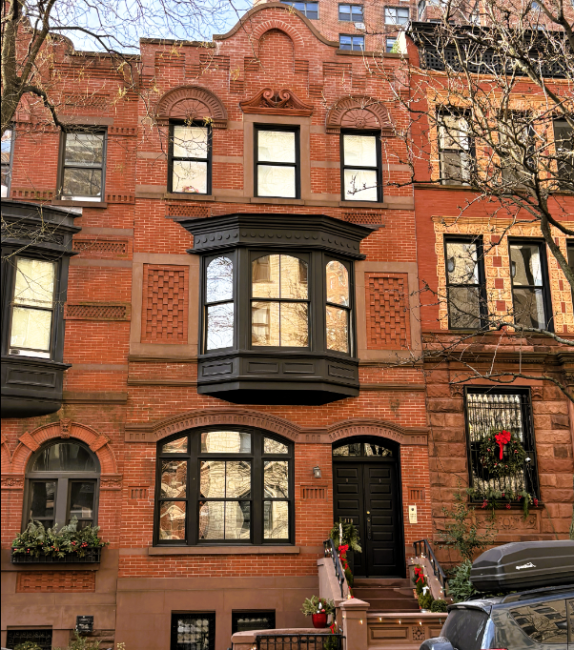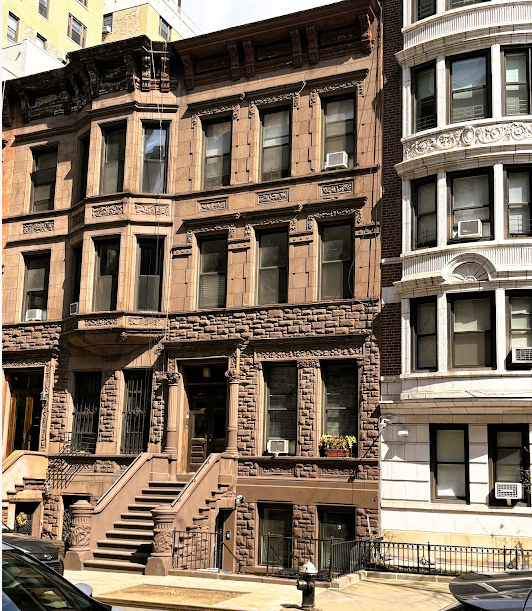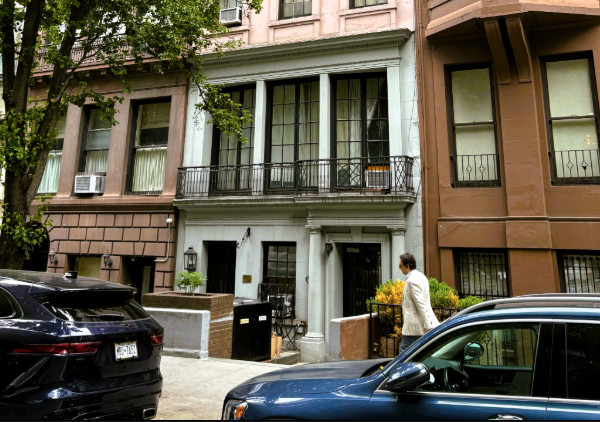





The 1890 William Baldwin House at 53 West 74th St: An ambitious design for a series of ambitious owners
- Intricate Renaissance Revival panels decorate the lower floors with neo-Grec details above
- One prominent owner was Jeannette M. Thurber, known as a classical music patron

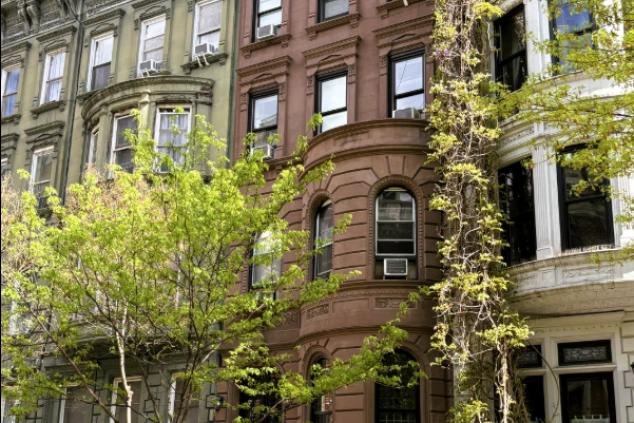
The deeply rusticated parlor and second floors of 53 West 74th St. were distinguished by a pronounced rounded bay.
Have you ever passed by an interesting residential building in New York City and wanted to know more about its history? In this series, Brick Underground teams up with Tom Miller, creator of Daytonian in Manhattan, a blog about Manhattan buildings and other historic architecture. Each week, we run an excerpt from the Daytonian’s archives with a link to the full article.
The architectural and developer firm of Colleran & Brother & Hughes in 1890 completed a row of four, high-end residences on West 74th Street between Central Park West and Columbus Avenue. The 20-foot-wide houses were four stories tall above high English basements and faced in brownstone.
The deeply rusticated parlor and second floors of 53 West 74th St. were distinguished by a pronounced rounded bay. A dog-legged box stoop meandered up to the arched doorway, which was protected by iron-and-glass doors and outlined by delicate rope molding. A fearsome lion's head decorated its keystone. Intricate Renaissance Revival panels embellished these levels and also appeared at the bases of the parlor openings.
The architect turned to neo-Grec for the planar faced upper floors. The windows sat within elaborate carved architraves. Equally ambitious was the pressed metal cornice with its paired, scrolled corbels and decorated fascia panels.
Max Weil purchased all four houses in January 1891. When he sold them at auction on July 3rd William Burnet Baldwin placed the winning bid of $43,900 for No. 53. The price would translate to just over $1.5 million in 2026.
William Burnet Baldwin and his wife Irene, had at least one son, William R. Also moving into the house was his mother, Phebe Baldwin.
Baldwin was a builder and just two months after moving into 53 West 74th St. he began construction on two stables on West 76th Street. Phebe Ann Baldwin died in the house at the age of 84 on April 13th, 1894. Her funeral was held in the parlor three days later.
Somewhat surprisingly, William and Irene sold 53 West 74th St. for a tidy profit to their son, William R. Baldwin in March 1896 for $47,250. The transaction initiated a flurry of deed transfers. The same day, William R. Baldwin transferred the title to Samuel F. Adams who sold it almost immediately to Jacques Richard Simon, the head of the silk importing firm J. R. Simon & Co.
The property changed hands several more times in the decades to come.
On May 26th, 1925, The New York Times reported that 53 West 74th St. had been sold for $50,000. The buyer was Jeannette M. Thurber, known nationally as a patron of classical music. In 1884, Thurber sponsored the city's first Wagner festival and the following year founded the National Conservatory of Music of America and the American Opera Company.
A renovation completed in 1969 resulted in a duplex in the basement and parlor levels, and apartments and furnished rooms in the upper floors. The configuration lasted until 1980 when the three upper floors were converted to two apartments each.
For more on this property and its inhabitants, check out the full article.
You Might Also Like