




The 1887 Henry and Helen Hirsch House at 116 East 95th St: A parade of wealthy occupants
- The property changed hands many times while remaining a single-family home
- Owners included a Plymouth Colony descendant and colonel in the U.S. Army

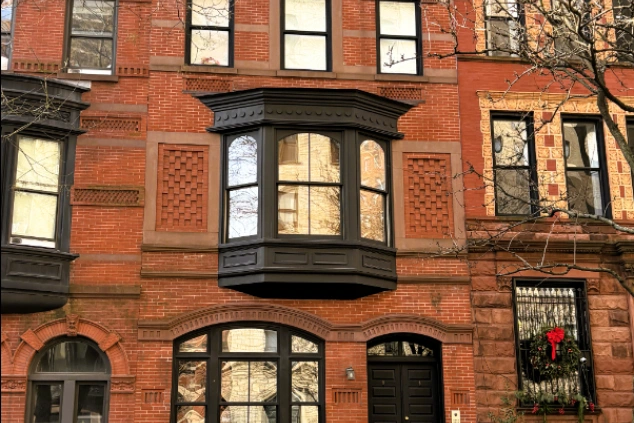
The architectural firm C. Abbott French & Co. turned to the popular and often whimsical Queen Anne style.
Have you ever passed by an interesting residential building in New York City and wanted to know more about its history? In this series, Brick Underground teams up with Tom Miller, creator of Daytonian in Manhattan, a blog about Manhattan buildings and other historic architecture. Each week, we run an excerpt from the Daytonian’s archives with a link to the full article.
In 1887, developer brothers William J. and John P. C. Walsh planned an ambitious project: A row of 12 houses on the south side of the 95th Street block between Lexington and Park avenues. The steeply sloping site was known as Goat Hill. The architectural firm C. Abbott French & Co. turned to the popular and often whimsical Queen Anne style.
Like its neighbors, 116 East 95th St. was three stories tall above a brownstone fronted basement. A dog-legged box stoop rose to the segmentally arched doorway topped with a terra cotta lintel connected to the window creating a graceful, wavelike effect. A cast metal oriel, flanked by basketweave brick panels, dominated the second floor. Elaborate terra cotta decorations on the third floor featured sunbursts and mythical faces, and the central opening was topped with a draped swans' head pediment. Rather than a cornice, the house was completed with an arched brick parapet supported by a complex brick corbel table.
The house changed hands in quick succession. The original owner, James R. Cuming, lost it in foreclosure in 1891 to Daniel P. Mahoney, who immediately sold it to Henry Wallach, who sold it to the Irving and Mollie Hirschfeld in May 1895. The couple paid $16,500 for the house, or about $636,000 in 2026.
The Hirschfelds, too, would not remain. On April 12th, 1902, they announced the engagement of their daughter, Minnie, to Henry Cohen. Before the end of the year, they had sold 116 East 95th St. to Henry Hirsch and his wife, the former Helen Ella Gattman. The couple, who were married in 1864, had seven adult children. In July 1903, only months after purchasing No. 116, the couple hired architect J. Berry to make the equivalent of $276,000 today in interior renovations.
Henry Hirsh died in the house at the age of 77 on May 26th, 1916.
Four years later, The New York Times reported that Helen Ella Hirsch had sold the 20-foot-wide house. The buyers were Latham Gallup Reed and his wife, the former Mary Newbold Welsh. An attorney, Reed was descended from members of the Plymouth Colony.
Decades later, in 1946, 116 East 95th St. was sold to Colonel George Leonidovich Artamonoff and his wife, the former Jessie Downing. Born in Kursk, Russia, Artamonoff's father was General Leonid Konstantinovich Artamonoff of the Imperial Russian Army. George fought in the White Army in 1919 before fleeing to the U.S. in 1921.
At the outbreak of World War II, Artamonoff was commissioned a major in the U.S. Army and was later made "director of the Tokyo office of the Marshall Plan," charged with "restoring economic relations between Japan and countries of Southeast Asia." The Artamonoffs leased the house until June 1949, when they sold it.
The subsequent occupants of the residence continued to be affluent.
The house, still a single-family home, was renovated in 2020. It was most likely at this time, that the stained-glass in the parlor floor transoms were removed in the process of replacing the windows.
For more on this property and its parade of wealthy inhabitants, check out the full article.
You Might Also Like