




The 1891 Larom House at 219 West 78th St: A hybrid Romanesque and Renaissance Revival design
- The house was converted to seven apartments after its purchase in 1962 by architect Alexander Feingold

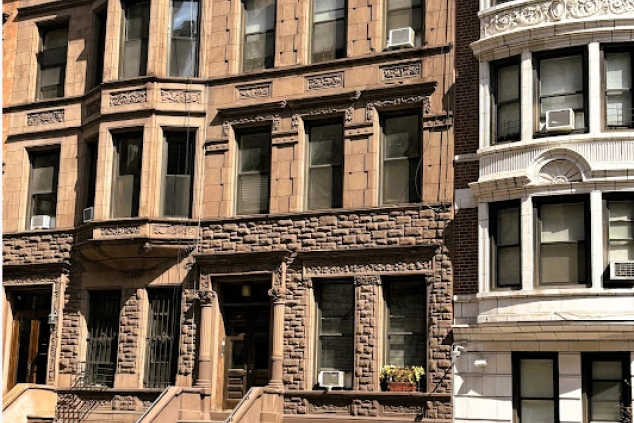
The basement and parlor levels were clad in chunky, undressed brownstone blocks, typical of the Romanesque Revival style. The Renaissance influence can be seen it the sumptuous fruit-and-flower carvings in the lintel.
Have you ever passed by an interesting residential building in New York City and wanted to know more about its history? In this series, Brick Underground teams up with Tom Miller, creator of Daytonian in Manhattan, a blog about Manhattan buildings and other historic architecture. Each week, we run an excerpt from the Daytonian’s archives with a link to the full article.
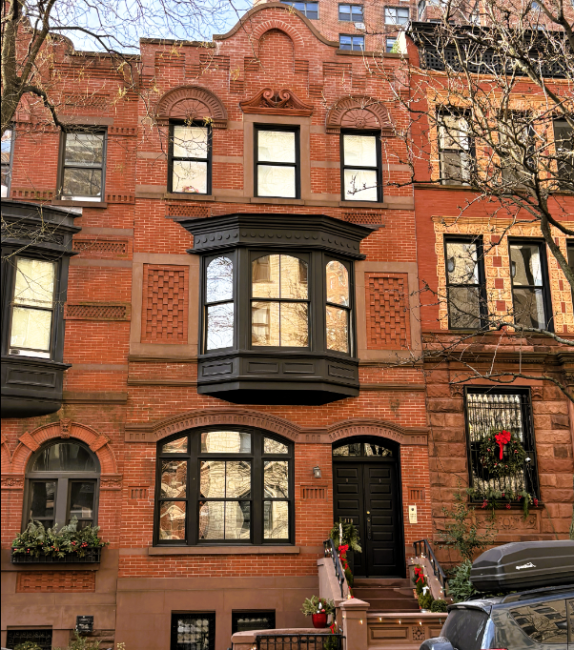
In 1890, William H. Hall Jr. and T. R. A. Hall, part of an extended family that worked as builders and developers, purchased 10 building lots on the northern side of West 78th Street between Broadway and Amsterdam Avenue. They hired the architectural firm of Thom & Wilson to design upscale, three-story-and-basement homes. Completed in 1891, they wore Romanesque Revival pants and Renaissance Revival shirts.
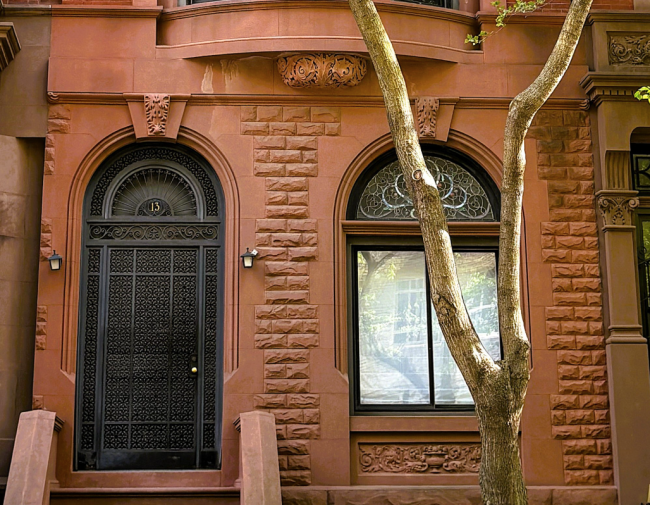
Among them was 219 West 78th St: Its basement and parlor levels were clad in chunky, undressed brownstone blocks, typical of the Romanesque Revival style. Beefy carved stoop newels continued the motif. Thom & Wilson introduced the Renaissance at the parlor floor with sumptuous fruit-and-flower carvings in the single lintel that connected the windows and above the doorway. Formal fluted columns with complex capitals flanked the entranceway.
The second and third floor windows within the planar brownstone surface were framed by shallow quoins and capped with lintels carved with intricate swags of fruits and flowers. A pressed metal cornice with paired corbels completed the design.
The house underwent a quick succession of owners until about 1896 when glove importer Frank William Larom and his wife, the former Elizabeth Elmira Shute, moved in. They had two children, Irving Hastings and Edith Emerson.
Edith Emerson Larom was 12 years old when she died on April 21st, 1905. The little girl's casket sat in the parlor until her funeral there on April 24th.
The 1914 Social Register listed Irving Hastings Larom as living in the Cottage Club at Princeton University. Known as Larry, after his graduation the following year, he relocated to the Far West with Winthrop Brooks of the Brooks Brothers family. They established Valley Ranch, a dude ranch near Cody, Wyoming. An ad for the place noted, "You'd enjoy wearing ranch clothes, the cowboys, the ranch work, the saddle-leather atmosphere of the place."
The 219 West 78th St. property saw a succession of owners and was remodeled again after the Feingold Realty Corporation purchased it in September 1962. The owner was architect Alexander Feingold. He reconfigured the interior to seven apartments while preserving the exterior appearance.
At the time of Feingold's purchase, the neighborhood had severely declined. Thirty-five years later, Feingold still lived here. He recalled his early years there to The New York Times journalist Christopher Gray in 1995, saying, "the block was plagued by prostitution and drugs." Feingold and his neighbors turned things around. Gray reported, "An early step forward, around 1966, was the planting of trees by the Department of Parks, followed by brick enclosures Mr. Feingold's firm designed for the tree pits a few years later."
There are still seven apartments in the building and Thom & Wilson's interesting hybrid design is amazingly intact.
For more on this property and its inhabitants, check out the full article.