




The Al Hirschfeld House at 122 East 95th St: Where a renowned caricaturist refined his celebrity portraits
- Hirschfeld hid the name of his daughter Nina in his drawings for New York Times readers to find
- He created a top-story studio and had the facade painted pink, among other improvements

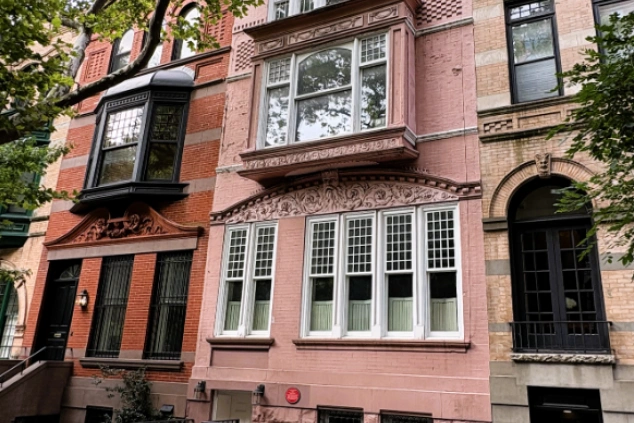
The upper sashes of the grouped parlor windows contained myriad small panes typical of the Queen Anne style.
Have you ever passed by an interesting residential building in New York City and wanted to know more about its history? In this series, Brick Underground teams up with Tom Miller, creator of Daytonian in Manhattan, a blog about Manhattan buildings and other historic architecture. Each week, we run an excerpt from the Daytonian’s archives with a link to the full article.
On February 19th, 1887, the Real Estate Record & Builders' Guide reported that developers William J. and John P. Walsh and the architectural firm of C. Abbott French & Co. had teamed up again for a row of 12 "Queen Anne private residences" on East 95th Street between Park and Lexington avenues. Completed in 1888, each of the three-story residences would cost about $490,000 in 2026 money to erect.
Among the most eye-catching was 122 East 95th St., with a yellow brick facade contrasted by ruddy terra cotta. A dog-legged box stoop rose to the entrance. The upper sashes of the grouped parlor windows contained myriad small panes typical of the Queen Anne style.
Real estate operator Lewis Coon purchased 120 and 122 East 95th St., painted and wallpapered the interiors, and then put them back on the market in September 1889. Asking $20,000 each, Coon said buyers would find "no equal for the money on the island."
Lewis Coon sold 122 East 95th St. to Elias Einstein in July 1890. Born in 1830, Einstein was the head of a cloak manufacturing firm. He and his wife had two adult daughters, Ida and Hannah, both were married.
In 1893, Ida moved in along with her nine-year-old twins. Ida had married Jacob Rothschild in 1883—he worked in a large mercantile house but he "became dissipated" (the term most often referred to alcoholism) and lost his job and, finally, Ida went back to live with her father.
On the morning of May 19th, 1895, a servant heard a noise in the vestibule. He found Jacob Rothschild lying on the floor. The New York Herald said that Rothschild was "breathing laboriously and in his hand was a small bottle partly filled with some liquid." He mumbled, "You won't have any more trouble on my account. I have taken this poison, and I came here to die." He died shortly afterward.
Later, the house changed hands a couple times to owners who rented it out until December 1947 when it was sold to artist Albert Hirschfeld, who was The New York Times’ caricaturist. Dolly Hass Hirschfeld was his second wife and they had a daughter, Nina. Her name was always hidden in capital letters in her father's caricatures and finding them became a Sunday morning quest for Times readers.
Hirschfeld created a top-story studio and had the yellow brick and terra cotta painted a cheery pink, among other changes.
For decades Hirschfeld sat in theaters with his sketch pad, then returned to his studio to create his final images. Some of the artworks were recreated in the hand-painted fireplace tiles and wallpaper panels, including portraits of Charlie Chaplin, Frank Sinatra, and Marilyn Monroe among other stars.
Hirschfeld passed in 2003 at age 99 and in February 2011, the Wall Street Journal reported his townhouse sold for more than the $5.3 million asking price after a bidding war.
No. 122 East 95th St. still sports pink paint and continues to be a standout on C. Abbott French & Co.'s picturesque row.
For more on this property and its inhabitants, check out the full article.
You Might Also Like