




The Eufrasia and Allen Tucker Mansion at 121 East 79th St: Where the ‘American Van Gogh’ painted
- An extensive 1906 redesign with a neo-Georgian facade cost the Tuckers $10,000
- Allen Tucker’s impressionist paintings were hung in prestigious U.S. museums

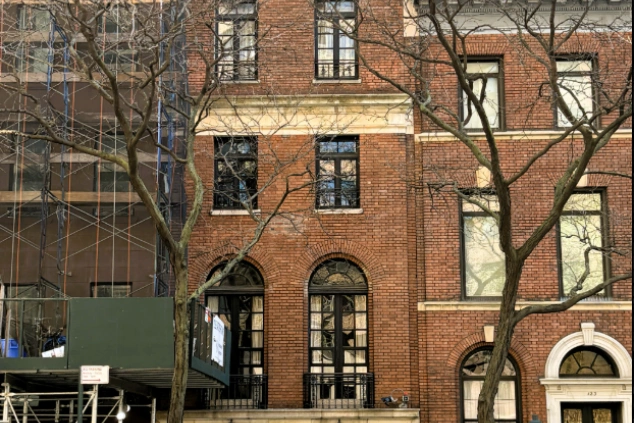
The young owners removed the stoop and brownstone and created a neo-Georgian-style facade.
Have you ever passed by an interesting residential building in New York City and wanted to know more about its history? In this series, Brick Underground teams up with Tom Miller, creator of Daytonian in Manhattan, a blog about Manhattan buildings and other historic architecture. Each week, we run an excerpt from the Daytonian’s archives with a link to the full article.
Eufrasia Aguilar Leland Wesson and Allen Tucker were married on February 12th, 1895. The 25-year-old bride was reared in privilege, the daughter of the late Charles Howland Wesson and Martha Leland. The groom, who was four years older than Eufrasia, earned his architectural degree from Columbia University in 1887 and worked as a draftsman at his father's firm, McIlvaine & Tucker.
In 1906, Eufrasia's mother Emma Wesson and aunt Eufrasia A. Leland purchased two vintage houses at 123 and 125 East 79th Street as the site of their double-wide mansion. Eufrasia and Allen Tucker purchased the house next door and hired the firm of Robins & Oakman to make extensive alterations. Their redesigning of the high-stooped brownstone would transform it into a modern residence.
On May 30th, 1906, the New-York Tribune described the changes: "A rear extension is to be added, new plumbing installed and a new Colonial facade, with a mansard roof built." The renovations would cost the Tuckers $10,000, or about $360,000 in 2026 terms.
Robins & Oakman removed the stoop and brownstone and created a neo-Georgian-style facade. Often when a stoop was removed from English basement homes, the front was pulled forward to the property line. For the Tucker residence however, a small front yard was created instead.
The rear extension held Allen Tucker's skylight-lit studio. He had moved from architecture to fine art. An impressionist, he was part of the group of painters known as the Independents, who "wanted to shake up the conservative ideas of the National Academy of Design." In 1911, Tucker co-founded the Association of American Painters and Sculptors, and in 1913 helped organize the famous Armory Show.
When America entered World War I, Tucker served with the American Ambulance Service in France. It appears that Eufrasia moved temporarily next door with her mother and aunt.
Starting in 1921, after returning to New York after the war, Allen Tucker taught at the Art Students League. Often deemed "the American Van Gogh," his paintings would hang in prestigious U.S. museums.
For more on this building and its inhabitants—who renovated the building extensively, check out the full article.